Relative Pronouns — The Relative Noun (الاِسْمُ الْمَوْصُولُ)
Connecting clauses in Quranic Arabic with الَّذِي، الَّذِينَ، الَّتِي، مَا، and مَنْ
- Define the relative noun (اِسْمٌ مَوْصُولٌ) and explain its function — connecting a definite noun to a following clause that clarifies it
- Identify the three most important specific relative nouns — الَّذِي، الَّتِي، الَّذِينَ — and state how many times each occurs in the Quran
- Explain what صِلَةُ الْمَوْصُولِ (the connecting clause) is and what types of clause may serve that role
- Recognise the non-specific relative nouns مَا (what / that / which) and مَنْ (who / whoever) and distinguish their relative use from their use as question words or negators
- Parse relative noun constructions from surah al-Fatihah, surah al-Mu'minun, and surah al-Baqarah
Video Lesson
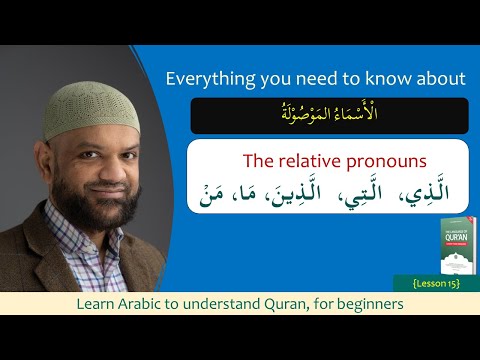 Click to play
Key Vocabulary
| Arabic | Transliteration | Meaning | Type |
|---|---|---|---|
| اِسْمٌ مَوْصُولٌ | ismun mawsuul | relative noun — a noun that connects two clauses | ISM |
| صِلَةُ الْمَوْصُولِ | silatu l-mawsuul | the connecting clause — the clause that follows the relative noun and completes its meaning | ISM |
| الَّذِي | alladhii | who / which / that (masculine singular) | ISM |
| الَّتِي | allatii | who / which / that (feminine singular) | ISM |
| الَّذِينَ | alladhiina | those who / who (masculine plural — rational beings) | ISM |
| مَا | maa | what / that / which (non-specific relative — also used for questions and negation) | HARF |
| مَنْ | man | who / whoever (non-specific relative — used primarily with rational beings) | ISM |
| عَاقِلٌ | `aaqil | rational — a living being capable of reason (human, jinn, angel) | ISM |
| غَيْرُ عَاقِلٍ | ghayru `aaqil | non-rational — inanimate objects, animals, and plants | ISM |
| صِرَاطَ الَّذِينَ أَنْعَمْتَ عَلَيْهِمْ | siraata lladhiina an`amta `alayhim | the path of those upon whom You have bestowed favour | ISM |
Introduction
Lesson 15 is the final lesson of Book One. Throughout this course we have built a systematic understanding of Arabic: the three types of words, the four properties of the noun, the various phrase types, the nominal sentence, and the particles (inna and her sisters, negation, questions). In this last lesson we complete the map of definite noun categories begun in lesson 2 by studying the final major category: the relative noun (اِسْمٌ مَوْصُولٌ).
Relative nouns appear approximately 3,500 times in the Quran. They are the mechanism by which Arabic links a noun to additional descriptive information — the Arabic equivalent of the English words "who," "which," and "that" as used in relative clauses. Mastering even the three most common relative nouns (الَّذِي، الَّتِي، الَّذِينَ) accounts for over 1,400 individual word occurrences in the Quran. This lesson introduces the concept, presents the full set, and gives detailed Quranic illustrations.
The Concept
### What Is a Relative Noun?
A relative noun (اِسْمٌ مَوْصُولٌ — literally "the connected noun") is a word that links a previously mentioned definite noun to a following clause that provides more information about it. In English: "the man who came," "the book which is on the table," "those who believe."
The key structural requirement is that the relative noun must always be followed by its connecting clause (صِلَةُ الْمَوْصُولِ), which is essential to complete the meaning. The relative noun alone gives no complete information — الَّذِي by itself just means "the one who..." and leaves us waiting.
الاِسْمُ الْمَوْصُولُ always: 1. Follows a definite noun (the noun it connects back to) 2. Is itself always definite (it is one of the seven categories of definite nouns) 3. Is mabni — its ending does NOT change for case (raf`a, nasab, jarr) 4. Is followed immediately by صِلَةُ الْمَوْصُولِ (the connecting clause) صِلَةُ الْمَوْصُولِ may be: — A nominal sentence (جُمْلَةٌ اِسْمِيَّةٌ) — A verbal sentence (جُمْلَةٌ فِعْلِيَّةٌ) — A shibhu jumlah: jar-majruur OR dharf + mudaf ilayhi
### The Specific Relative Nouns
These words are used exclusively as relative nouns — they have no other grammatical function. Of the full set, three dominate Quranic usage completely:
| Form | Use | Quranic occurrences | |------|-----|---------------------| | الَّذِي | Masculine singular (rational or non-rational) | 304 | | الَّتِي | Feminine singular (rational or non-rational; also broken plurals of non-rational) | 68 | | الَّذِينَ | Masculine plural (primarily rational beings) | 1,059 |
The dual forms (اللَّذَانِ / اللَّتَانِ) each appear only twice in the entire Quran. The feminine plural (اللَّاتِي) appears 9 times, and اللَّائِي 4 times. For practical Quranic reading, three words suffice.
Three words cover the vast majority of relative noun usage in the Quran: الَّذِي — singular masculine (or any non-rational noun) الَّتِي — singular feminine (and non-rational broken plurals, treated as sing. fem.) الَّذِينَ — plural masculine (the most common: 1,059 occurrences) All three are mabni — they do NOT change their ending regardless of grammatical case.
### Using الَّذِي with Non-Rational Nouns
الَّذِي may refer back to non-rational nouns (غَيْرُ عَاقِلٍ) as well as to rational beings. When a non-rational broken plural is the antecedent, Arabic treats it as singular feminine — therefore الَّتِي is used, just as with the demonstratives (lesson 12).
Example: اَلْكُتُبُ الَّتِي عَلَى الْمَكْتَبِ جَدِيدَةٌ — "The books which are on the table are new." Though كُتُبٌ is a broken plural, it is treated as singular feminine, so الَّتِي is used.
### The Non-Specific Relative Nouns (مَا and مَنْ)
Unlike the specific set above, مَا and مَنْ serve multiple grammatical roles in Arabic (question, negation, and relative). As relative nouns they are highly flexible — they do not distinguish gender, number, or rational/non-rational.
مَنْ (man) as a relative noun: — Primarily used with rational beings (humans, etc.) — Can be singular, plural, masculine, or feminine — Means "who" / "whoever" / "the one who" — Has been used approximately 650 times as a relative noun in the Quran مَا (maa) as a relative noun: — Generally used with non-rational referents (though not exclusively) — Can mean "what," "that which," "whatever" — Has been used approximately 1,476 times as a relative noun in the Quran — Distinguish from: مَا as negator (lesson 13), مَا as question word (مَا هَذَا?)
Quranic Evidence
Summary
- A relative noun (اِسْمٌ مَوْصُولٌ) connects a definite noun to a following clause (صِلَةُ الْمَوْصُولِ) that completes and clarifies it. It is always definite and always mabni (does not change for case).
- The three essential specific relative nouns are الَّذِي (masculine singular — 304 times), الَّتِي (feminine singular — 68 times), and الَّذِينَ (masculine plural — 1,059 times). Learning these three words gives access to over 1,400 Quranic occurrences.
- الَّتِي is used for feminine singular nouns and also for non-rational broken plurals, which are treated as singular feminine throughout Arabic grammar (consistent with the demonstrative rule from lesson 12).
- The non-specific relative nouns مَا (what / that which — ~1,476 relative uses) and مَنْ (who / whoever — ~650 relative uses) are flexible: they do not change for gender, number, or rationality. مَا has several other functions (negation, questions) and must be distinguished by context.
- صِلَةُ الْمَوْصُولِ may be a full sentence (nominal or verbal) or a shibhu jumlah (prepositional phrase or adverbial idafah). Verbal sentences as the connecting clause will be studied in depth in Book Two.