Emphasis in the Jumlah Ismiyyah
إنَّ with pronouns · Lam of emphasis · إنَّمَا · Pronoun of separation
- Attach the 14 pronouns to إنَّ and read them correctly (إِنِّي، إِنَّهُ، إِنَّكَ etc.)
- Recognise the lam of emphasis (لَام التَّوْكِيد) and understand it causes no change in irab
- Combine إنَّ and lam together for double emphasis in a sentence
- Understand how إنَّمَا neutralises the grammatical impact of إنَّ while adding exclusivity
- Use the pronoun of separation (ضَمِيرُ الفَصْل) to make a sentence restrictive in meaning
Video Lesson
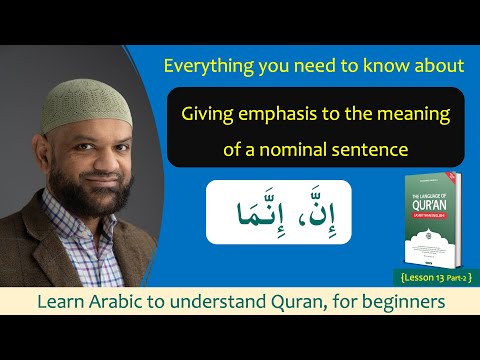 Click to play
Key Vocabulary
| Arabic | Transliteration | Meaning | Type |
|---|---|---|---|
| إِنَّهُ | innahu | indeed he / indeed it | إنَّ + attached pronoun |
| إِنِّي | innii | indeed I | إنَّ + ya mutakallim |
| إِنَّنِي | innanee | indeed I (alternate form with noon of protection) | إنَّ + noon of protection + ya |
| لَامُ التَّوْكِيد | lamut-tawkeed | the lam of emphasis — adds emphasis, no change to irab | grammatical term |
| لَامُ الاِبْتِدَاء | lamul-ibtidaa | lam of inception — the lam of emphasis at the start of a sentence | grammatical term |
| اللَّامُ الْمُزَحْلَقَة | allamul-muzahlaqa | the sliding lam — moves to the khabar when combined with إنَّ | grammatical term |
| إِنَّمَا | innama | only / nothing but / exclusively | harf (إنَّ + ما of neutralisation) |
| مَا الكَافَّة | mal-kaffa | the neutralising ma — removes the grammatical impact of إنَّ | grammatical term |
| ضَمِيرُ الفَصْل | damiirul-fasl | pronoun of separation — placed between mubtada and khabar to restrict meaning | grammatical term |
| نُونُ الوِقَايَة | noonul-wiqaya | noon of protection — added before ya mutakallim to protect the word ending | grammatical term |
Introduction
Having established in Part 1 how إنَّ changes the mubtada to nasab and adds emphasis, Part 2 builds on that foundation with three further tools of emphasis that appear throughout the Quran and hadith. These are the lam of emphasis (لَامُ التَّوْكِيد), the particle إنَّمَا, and the pronoun of separation (ضَمِيرُ الفَصْل). The lesson also covers how to attach all 14 Arabic pronouns to إنَّ — a skill that is immediately practical because إنَّ is used with pronouns on nearly every page of the Quran.
Understanding emphasis in Arabic unlocks a layer of meaning that is almost always lost in translation. When you read "Indeed Allah is forgiving" in English, you cannot tell whether the Arabic has single emphasis, double emphasis, or exclusive emphasis. By the end of this lesson, you will be able to see all three.
The Concept
### إنَّ with Attached Pronouns
When the subject of إنَّ is a pronoun (he, she, you, I etc.), you cannot use the detached (rafa) pronoun — هُوَ, أَنْتَ, أَنَا — because إنَّ requires its ism to be in nasab. The attached pronoun must be used instead.
The attached pronoun is written as a suffix to إنَّ and is itself in nasab because of إنَّ.
Example: Instead of إنَّ + هُوَ (impossible — هُوَ is always rafa), we say:
> إِنَّهُ صَالِحٌ — Indeed he is pious.
Here إِنَّهُ = إنَّ + هُ (the attached pronoun). The pronoun هُ is the ism of إنَّ (nasab), and صَالِحٌ is the khabar of إنَّ (rafa).
The 14 pronouns attached to إنَّ:
| Person | Attached form | Meaning | |--------|--------------|---------| | هُوَ | إِنَّهُ | indeed he | | هُمَا (m) | إِنَّهُمَا | indeed they two | | هُمْ | إِنَّهُمْ | indeed they (m) | | هِيَ | إِنَّهَا | indeed she / it | | هُمَا (f) | إِنَّهُمَا | indeed they two (f) | | هُنَّ | إِنَّهُنَّ | indeed they (f) | | أَنْتَ | إِنَّكَ | indeed you (m.sg) | | أَنْتُمَا | إِنَّكُمَا | indeed you two | | أَنْتُمْ | إِنَّكُمْ | indeed you (m.pl) | | أَنْتِ | إِنَّكِ | indeed you (f.sg) | | أَنْتُمَا | إِنَّكُمَا | indeed you two (f) | | أَنْتُنَّ | إِنَّكُنَّ | indeed you (f.pl) | | أَنَا | إِنِّي / إِنَّنِي | indeed I | | نَحْنُ | إِنَّا / إِنَّنَا | indeed we |
Note on the first person (أَنَا): The ya mutakallim always requires a kasra before it. When attached to إنَّ, either the noon of إنَّ takes a kasra (giving إِنِّي) or a noon of protection (نُونُ الوِقَايَة) is inserted (giving إِنَّنِي). Both are used in the Quran and both are correct.
Detached pronouns (هُوَ، أَنْتَ، أَنَا) are always marfu and cannot follow إنَّ. Use the attached pronoun instead — it becomes the ism of إنَّ in nasab.
### The Lam of Emphasis (لَامُ التَّوْكِيد)
The lam of emphasis is a separate tool from إنَّ. It is placed before a word to give emphasis in meaning only — it causes no change whatsoever in the irab of the word it precedes.
When it comes at the beginning of a sentence it is called لَامُ الاِبْتِدَاء (lam of inception):
> لَزَيْدٌ صَادِقٌ — Certainly Zayd is truthful.
No change to the irab. The mubtada remains rafa. The meaning is simply strengthened.
When إنَّ and lam are combined for double emphasis, إنَّ comes first (before the ism) and the lam moves to the khabar. This lam is called اللَّامُ الْمُزَحْلَقَة (the sliding lam) because it slides away from the beginning to sit before the khabar:
> إِنَّ زَيْدًا لَصَادِقٌ — Indeed, Zayd is most certainly truthful.
Here the ism زَيْدًا is in nasab (due to إنَّ) and the lam precedes the khabar صَادِقٌ for double emphasis.
Lam of emphasis: adds emphasis in meaning only — no change to irab. Combined إنَّ + lam: إنَّ before the ism (nasab), the sliding lam before the khabar (rafa). This gives double emphasis.
### إنَّمَا — Emphasis with Exclusivity
When the particle مَا is added to إنَّ, forming إِنَّمَا, it is called مَا الكَافَّة (the neutralising ma). It does two things:
- Removes the grammatical impact of إنَّ — so the ism after إنَّمَا remains in rafa, not nasab.
- Adds exclusive meaning — the sentence now means only or nothing but.
> إِنَّمَا الْمُؤْمِنُونَ إِخْوَةٌ — The believers are nothing but brothers.
Note: الْمُؤْمِنُونَ stays in rafa (marfu) — there is no nasab change because of the neutralising ma.
إنَّمَا = إنَّ + مَا (neutralising ma) The grammatical impact of إنَّ is removed — no nasab. The meaning becomes exclusive: "only" / "nothing but".
إنَّمَا is used 145 times in the Quran.
### Pronoun of Separation (ضَمِيرُ الفَصْل)
A pronoun of separation is placed between the mubtada and the khabar to make the meaning exclusive or restrictive. It matches the mubtada in number and gender:
> اللهُ هُوَ الْغَفُورُ — Allah is the one and only All-Forgiving.
Without the pronoun of separation: اللهُ الْغَفُورُ could be read as a descriptive phrase (mudaf-mudaf ilayhi issue). The pronoun هُوَ between them fixes the meaning as a Jumlah Ismiyyah and adds exclusivity — the forgiveness belongs to Allah alone.
The pronoun of separation can be used together with إنَّ and lam for layered emphasis:
> إِنَّ اللهَ هُوَ الْغَفُورُ — Indeed Allah is the one and only All-Forgiving.
Quranic Evidence
Summary
- The 14 attached pronouns attach directly to إنَّ as its ism (nasab) — the khabar remains rafa. Memorise the full chart: إِنَّهُ، إِنَّهَا، إِنِّي، إِنَّا etc.
- The lam of emphasis adds emphasis in meaning with no change to irab. When combined with إنَّ, the lam slides to sit before the khabar — creating double emphasis (اللَّامُ الْمُزَحْلَقَة).
- إنَّمَا = إنَّ + مَا of neutralisation. It removes the nasab requirement, keeps the word after it in rafa, and adds the exclusive meaning of "only" or "nothing but."
- The pronoun of separation (ضَمِيرُ الفَصْل) sits between mubtada and khabar, makes the sentence restrictive in meaning, and can be combined with إنَّ and lam for triple-layered emphasis.
- Much of this depth of meaning is lost in English translation — learning these tools allows you to read the Quran with far greater understanding of what Allah is actually communicating.