Demonstrative Pronouns and the Demonstrative Phrase
Asmaa' ul-Isharah and Murakkab Ishaari
- Name and use the six essential demonstrative nouns — three for near (هَذَا، هَذِهِ، هَؤُلَاءِ) and three for far (ذَلِكَ، تِلْكَ، أُولَئِكَ)
- Explain why demonstrative nouns are always definite and always mabni (do not change their endings for case)
- Form a correct demonstrative phrase (مُرَكَّبٌ إِشَارِيٌّ) by matching the pointing word with a noun that carries ال, and make both agree in gender, number, and case
- Apply the broken-plural rule: non-rational broken plurals are treated as singular feminine when using demonstrative nouns
- Recognise the added detail encoded in the fuller forms of ذَلِكَ (ذَلِكُمَا، ذَلِكُمْ، ذَلِكُنَّ) — what the person being addressed and the pointed-to object tell us separately
Video Lesson
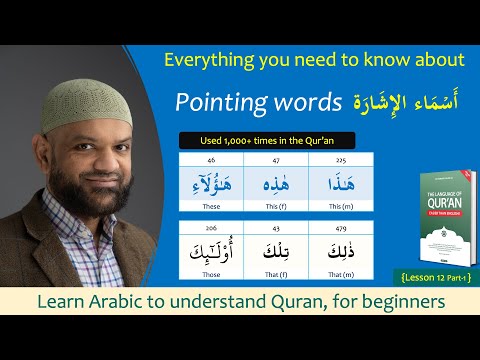 Click to play
Key Vocabulary
| Arabic | Transliteration | Meaning | Type |
|---|---|---|---|
| اِسْمُ الْإِشَارَةِ | ismu l-isharah | demonstrative noun (noun used for pointing) | ISM |
| مُشَارٌ إِلَيْهِ | musharun ilayhi | the thing being pointed to — the second part of a demonstrative phrase | ISM |
| هَذَا | haathaa | this (masculine singular — near) | ISM |
| هَذِهِ | haadhihi | this (feminine singular — near) | ISM |
| هَؤُلَاءِ | haa'ulaa'i | these (plural, masculine or feminine — near) | ISM |
| ذَلِكَ | dhaalika | that (masculine singular — far) | ISM |
| تِلْكَ | tilka | that (feminine singular — far) | ISM |
| أُولَئِكَ | ulaa'ika | those (plural, masculine or feminine — far) | ISM |
| مَبْنِيٌّ | mabnii | indeclinable — a word whose ending does not change due to grammatical case | ISM |
| كَذَلِكَ | kadhaaalika | like that / similarly (كَ is a harf of jarr here) | HARF |
Introduction
Having studied the four properties of the ism, the nominal sentence, and the idafah in detail, lesson 12 introduces an entirely new category of noun: the demonstrative (اِسْمُ الْإِشَارَةِ — the noun of pointing). Demonstratives are words used to direct attention to something specific — "this" or "that" in English. In Arabic they are treated as a fully-fledged category of ism with their own gender, number, and grammatical behaviour.
These words matter enormously for Quranic study: the demonstratives for near and far are used more than 1,060 times in the Quran — enough to encounter one or two on nearly every page of the mushaf. Understanding how they work also unlocks the demonstrative phrase (مُرَكَّبٌ إِشَارِيٌّ), a very common Quranic construction that is distinct from both the descriptive phrase and the idafah.
The Concept
### Demonstratives Are Always Definite
Demonstrative nouns are permanently definite. When you say "this pen," you are pointing to something specific — a particular pen — so it is by definition definite. This is one of the seven categories of definite nouns introduced in lesson 2. Because they are always definite, they can never take tanween.
### The Six You Must Know
Arabic has a full grid of demonstratives — singular, dual, and plural; masculine and feminine; near and far. However, the dual forms are almost entirely absent from the Quran (only one or two instances), and the plurals serve both genders. In practice, only six forms carry significant Quranic frequency:
| Distance | Masculine singular | Feminine singular | Plural (both genders) | |----------|-------------------|-------------------|----------------------| | Near | هَذَا (225 times) | هَذِهِ (47 times) | هَؤُلَاءِ (46 times) | | Far | ذَلِكَ (479 times) | تِلْكَ (43 times) | أُولَئِكَ (206 times) |
Demonstratives are mabni — their word ending does NOT change for case (raf`a, nasab, jarr). The grammatical case is determined by the role the demonstrative plays in its sentence, not by any visible change in the word itself. Context is the guide.
### Writing and Pronunciation Notes
- هَذَا is written without the final alif in standard Arabic script, but the alif is read — aided in the mushaf by the dagger alif (الأَلِفُ الْخَنْجَرِيَّةُ) written above the ذ.
- The واو in أُولَئِكَ is written but silent — read as أُولَئِكَ not وُولَئِكَ.
- هَذِهِ and هَؤُلَاءِ are read with elongated initial syllables; the mushaf uses special symbols to mark this correctly.
### The Demonstrative Phrase (مُرَكَّبٌ إِشَارِيٌّ)
The demonstrative phrase is the structure formed when a demonstrative noun is followed directly by a noun carrying ال. It means "this [noun]" or "that [noun]" — a phrase, not a complete sentence.
For a valid مُرَكَّبٌ إِشَارِيٌّ: 1. It begins with a demonstrative noun (اِسْمُ الْإِشَارَةِ) 2. It is followed immediately by a noun with ال (the مُشَارٌ إِلَيْهِ) 3. Nothing separates them 4. Both parts agree in gender, number, and case WITHOUT ال on the second word, you have a sentence, not a phrase: هَذَا مَسْجِدٌ → "This is a mosque." (jumlah ismiyyah — sentence) هَذَا الْمَسْجِدُ → "this mosque" (murakkab ishaari — phrase)
The مُشَارٌ إِلَيْهِ copies the grammatical case of the demonstrative, just as an adjective copies the case of the noun it describes in a descriptive phrase.
### Broken Plurals of Non-Rational Nouns
A key rule from lesson 4 applies directly here: broken plurals (جَمْعُ التَّكْسِيرِ) of non-rational nouns (things that are not human, jinn, or angel) are treated as singular feminine in Arabic grammar. This affects which demonstrative to use.
Broken plurals of non-rational nouns → use هَذِهِ or تِلْكَ (singular feminine) even when the noun refers to many objects. Example: أَبْوَابٌ (doors — broken plural of بَابٌ) → هَذِهِ الْأَبْوَابُ (these doors — treated as sing. fem.) كُتُبٌ (books — broken plural of كِتَابٌ) → هَذِهِ الْكُتُبُ (these books) Broken plurals of RATIONAL nouns (humans, etc.) may use either: → the plural demonstrative (هَؤُلَاءِ / أُولَئِكَ), OR → the singular feminine (هَذِهِ / تِلْكَ) Both are found in the Quran.
### The Hidden Detail of ذَلِكَ
The word ذَلِكَ is actually three components fused together: ذَا (the core pointing word) + لِ (indicating distance) + كَ (the pronoun representing the person being addressed). The كَ ending is not fixed — it changes to show whether the speaker is addressing a male, female, two people, or a group:
- ذَلِكَ — addressing one male
- ذَلِكِ — addressing one female
- ذَلِكُمَا — addressing two people
- ذَلِكُمْ — addressing a group of males (or mixed)
- ذَلِكُنَّ — addressing a group of females
This means Arabic encodes in a single word: (1) what is being pointed to, (2) how far away it is, and (3) who is being spoken to. English can only translate all of this as "that." Similarly, كَذَلِكَ (like that / similarly) adds a كَ harf of jarr at the front; since ذَلِكَ is mabni, the harf of jarr does not change its ending.
Quranic Evidence
Summary
- Demonstrative nouns (أَسْمَاءُ الْإِشَارَةِ) are a category of ism that is always definite and always mabni — their endings do not change for case. Grammatical role is determined by context.
- Only six forms carry significant Quranic frequency: هَذَا، هَذِهِ، هَؤُلَاءِ for near; ذَلِكَ، تِلْكَ، أُولَئِكَ for far. These appear over 1,060 times combined in the Quran.
- A demonstrative phrase (مُرَكَّبٌ إِشَارِيٌّ) requires a demonstrative noun followed immediately by a noun with ال, with both agreeing in gender, number, and case. No separation is permitted between the two parts.
- Non-rational broken plurals take the singular feminine demonstrative (هَذِهِ / تِلْكَ). Rational broken plurals may take either the plural or the singular feminine — both usages occur in the Quran.
- ذَلِكَ encodes three pieces of information: the pointing word, the mark of distance, and the pronoun of the person addressed. English renders all of this as simply "that."