Emphatic Negation and the Use of إِلَّا
Lā of Categorical Negation · Bā of Emphasis · إِلَّا for Exclusivity
- Understand لَا of categorical negation (lā al-jinsiyya) and its grammatical effect
- Use بِ with negation particles to form emphatic negation
- Use إِلَّا to express exception and positive exclusivity
- Recognise all three patterns in Quranic āyāt
Video Lesson
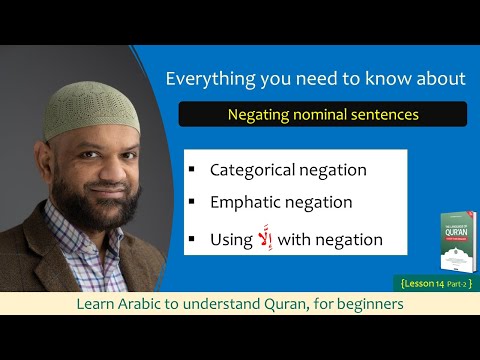 Click to play
Key Vocabulary
| Arabic | Transliteration | Meaning | Type |
|---|---|---|---|
| لَا | laa | no / categorical negation | HARF |
| إِلَّا | illaa | except / nothing but | HARF |
| إِكْرَاهٌ | ikraah | compulsion / coercion | ISM |
| ظَلَّامٌ | ẓallaam | unjust / greatly oppressive | ISM |
| غَافِلٌ | ghaafil | unaware / heedless | ISM |
| رَيْبٌ | rayb | doubt | ISM |
Introduction
In Part 1 we covered the three main tools for negating the nominal sentence — لَيْسَ، مَا، and لَا. Part 2 goes deeper into the most powerful forms of negation in Arabic: categorical negation with لَا النَّافِيَةُ لِلْجِنْسِ, emphatic negation using بِ, and the use of إِلَّا to express exception and exclusivity.
These structures appear on almost every page of the Quran. What often reads in translation as a simple negative carries in the Arabic original a far stronger force — an absolute, categorical denial of any possibility. Understanding this transforms how we read and hear the Quran.
The Concept
### لَا of Categorical Negation
This is one of the strongest negations in Arabic. Unlike ordinary لَا, it denies not just a single instance but the entire category — there is absolutely no possibility of the thing existing at all. It makes the following ISM mansūb (nasb) without tanwīn.
لَا + ISM (nasb, no tanwīn) = categorical negation "There is absolutely no possibility of [noun] existing."
Examples from the Quran and Hadith: لَا إِكْرَاهَ (no compulsion at all), لَا رَيْبَ (no doubt whatsoever), لَا نَبِيَّ بَعْدِي (absolutely no prophet after me). The sign: an indefinite noun after لَا in nasb without tanwīn.
### Emphatic Negation Using بِ
When بِ is added to the khabar after لَيْسَ or مَا, the negation becomes emphatic. The بِ forces the khabar into jarr and shifts the meaning from "is not" to "certainly is not."
- مَا حَامِدٌ شَيْخًا — Hāmid is not a scholar
- مَا حَامِدٌ بِشَيْخٍ — Hāmid is certainly not a scholar
### إِلَّا for Positive Exclusivity
When إِلَّا follows a negation it restricts meaning to one thing only — "nothing but", "none except." This can express high status, uniqueness, or absolute reliance on Allah alone.
Quranic Evidence
Summary
- لَا of categorical negation (لَا النَّافِيَةُ لِلْجِنْسِ) makes the following noun nasb without tanwīn — denying any possibility of the entire category.
- Emphatic negation: adding بِ to the khabar shifts from "is not" to "certainly is not."
- إِلَّا after negation restricts to one thing — exclusivity, unique status, or absolute reliance.
- لَا إِلَهَ إِلَّا اللَّهُ combines all three: categorical denial of any deity, followed by the exception — Allah alone.
- These patterns appear throughout the Quran; recognising them reveals layers of meaning invisible in translation.