إنَّ — Particle of Emphasis and Nasab
إنَّ and the Jumlah Ismiyyah · Ism of إنَّ · Khabar of إنَّ · Nasab endings
- Recognise إنَّ as a harf of nasab and emphasis (حَرْفُ النَّصْبِ وَالتَّوْكِيدِ)
- Identify the ism of إنَّ (اسْمُ إنَّ) and understand why it takes nasab
- Identify the khabar of إنَّ (خَبَرُ إنَّ) and understand why it stays marfu
- Apply إنَّ to a variety of nominal sentences including duals, plurals, and special word types
- Name the six sisters of إنَّ and state their shared grammatical behaviour
Video Lesson
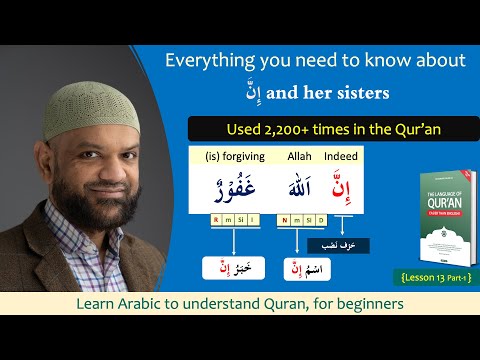 Click to play
Key Vocabulary
| Arabic | Transliteration | Meaning | Type |
|---|---|---|---|
| إِنَّ | inna | indeed / certainly / verily | harf (particle of nasab and emphasis) |
| حَرْفُ النَّصْبِ وَالتَّوْكِيدِ | harful-nasbi wat-tawkeed | particle of nasab and emphasis | grammatical term |
| اسْمُ إنَّ | ismu inna | the subject of إنَّ — takes nasab | grammatical term |
| خَبَرُ إنَّ | khabaru inna | the predicate of إنَّ — stays marfu | grammatical term |
| مَنْصُوب | mansoob | in the nasab (accusative) case | grammatical term |
| مَرْفُوع | marfoo | in the rafa (nominative) case | grammatical term |
| أَنَّ | anna | that / verily (mid-sentence form of إنَّ) | harf |
| كَأَنَّ | ka-anna | as if / as though | harf |
| لَيْتَ | layta | if only / I wish | harf |
| لَكِنَّ | lakinna | but / however / on the contrary | harf |
| لَعَلَّ | la-alla | perhaps / hopefully / maybe | harf |
Introduction
إنَّ is one of the most frequently used words in the Quran, appearing 1,682 times alone. Open any page of the standard Mus-haf and you will find it several times. Understanding how إنَّ works is therefore not an optional extra — it is foundational.
This lesson introduces إنَّ as the lead member of a family of six particles collectively known as إنَّ وَأَخَوَاتُهَا (Inna and her sisters): إنَّ، أنَّ، كَأنَّ، لَيْتَ، لَكِنَّ، لَعَلَّ. All six share the same grammatical impact on the nominal sentence (الجُمْلَةُ الاسْمِيَّة), and together they appear over 2,200 times in the Quran. If you have followed the previous lessons on the Jumlah Ismiyyah, the Huruf of Jar, and the Mudaf-Mudaf Ilayhi, this lesson will feel like a natural and rewarding next step.
The Concept
### What إنَّ Does to the Nominal Sentence
A standard Jumlah Ismiyyah has a مُبْتَدَأ (subject) in rafa and a خَبَر (predicate) also in rafa:
> اللهُ غَفُورٌ — Allah is forgiving.
When إنَّ is placed at the front of this sentence, two things happen simultaneously:
- Emphasis is added to the meaning — the sentence now conveys: Indeed / Certainly Allah is forgiving.
- The مُبْتَدَأ changes from rafa to nasab — it is no longer called mubtada but اسْمُ إنَّ (ism of inna).
- The خَبَر stays in rafa — it is now called خَبَرُ إنَّ (khabar of inna).
> إِنَّ اللهَ غَفُورٌ — Indeed, Allah is forgiving.
إنَّ + [اسْمُ إنَّ: nasab] + [خَبَرُ إنَّ: rafa] The subject (ism of inna) always takes nasab. The predicate (khabar of inna) always stays marfu.
### How Nasab Shows on Different Word Types
The nasab change is expressed differently depending on the word type — this is where all the earlier lessons come together:
- Regular nouns (e.g. حَامِد): rafa = حَامِدٌ → nasab = حَامِدًا → result: إِنَّ حَامِدًا صَالِحٌ
- Diptotes (e.g. إِبْرَاهِيم): no tanween in any case — rafa = إِبْرَاهِيمُ → nasab = إِبْرَاهِيمَ → result: إِنَّ إِبْرَاهِيمَ عَالِمٌ
- Indeclinables (e.g. مُوسَى، هَذَا): the ending does not visibly change, but the word is grammatically in nasab because of إنَّ
- Sound masculine plural (e.g. مُؤْمِنُونَ): rafa = مُؤْمِنُونَ → nasab/jar = مُؤْمِنِينَ → result: إِنَّ الْمُؤْمِنِينَ شَاكِرُونَ
- Dual (e.g. مُسْلِمَانِ): rafa = مُسْلِمَانِ → nasab/jar = مُسْلِمَيْنِ → result: إِنَّ الْمُسْلِمَيْنِ صَادِقَانِ
- The Five Nouns (أَب، أَخ etc.): rafa uses waw (أَبُو), nasab uses alif (أَبَا), jar uses ya (أَبِي) → result: إِنَّ أَبَا حَامِدٍ عَالِمٌ
إنَّ always puts its ism (the original mubtada) into nasab. The khabar of إنَّ always remains marfu — this never changes.
### The Khabar of إنَّ Coming Before the Ism
When the khabar of إنَّ is a shibh ul-jumlah (a jar-majroor phrase or an adverbial mudaf structure), and the ism of إنَّ is indefinite, the khabar may — and often does — come first. This is a recognised and beautiful pattern in Quranic style. The khabar in such cases is called a muta-alliq (مُتَعَلِّق), connected to a hidden verb.
If the ism of إنَّ is indefinite and the khabar is a shibh ul-jumlah, the khabar comes first and the ism of إنَّ comes at the end.
### The Six Sisters of إنَّ
All six particles share the same grammatical rule — they take their ism into nasab and leave the khabar in rafa. They differ in meaning:
| Particle | Meaning | |----------|---------| | إِنَّ | indeed / certainly | | أَنَّ | that / verily (mid-sentence) | | كَأَنَّ | as if / as though | | لَيْتَ | if only / I wish | | لَكِنَّ | but / however | | لَعَلَّ | perhaps / hopefully |
Quranic Evidence
Summary
- إنَّ is a harf of nasab and emphasis (حَرْفُ النَّصْبِ وَالتَّوْكِيدِ), appearing 1,682 times in the Quran.
- It converts the مُبْتَدَأ into اسْمُ إنَّ in nasab, while the خَبَرُ إنَّ stays in rafa.
- The nasab ending is expressed differently by different word types — some show a visible ending change, others (like مُوسَى or هَذَا) are grammatically nasab even though their form does not change.
- إنَّ is the lead member of a family of six particles — إنَّ، أنَّ، كَأنَّ، لَيْتَ، لَكِنَّ، لَعَلَّ — all sharing the same grammatical rule but each with its own distinct meaning.
- When the khabar is a shibh ul-jumlah and the ism is indefinite, the khabar precedes the ism — a common and meaningful Quranic word-order pattern.