Demonstratives in the Quran — Pronouns of Separation and Quranic Examples
ضَمِير الفَصْل · far demonstratives for emphasis · seven Quranic examples analysed
- Understand what the pronoun of separation (ضَمِير الفَصْل) is, why it is used, and how to choose the correct pronoun form
- Recognise that far demonstratives (ذَلِكَ، تِلْكَ، أُولَئِكَ) are sometimes used in the Quran when referring to something near, for the purpose of emphasis
- Analyse real Quranic passages containing demonstratives and identify the murakkab ishaari, murakkab tawsifi, murakkab idafi, and jumla ismiyya structures within them
- Read Surah Al-Baqarah 2:5 in full and parse every grammatical structure it contains
Video Lesson
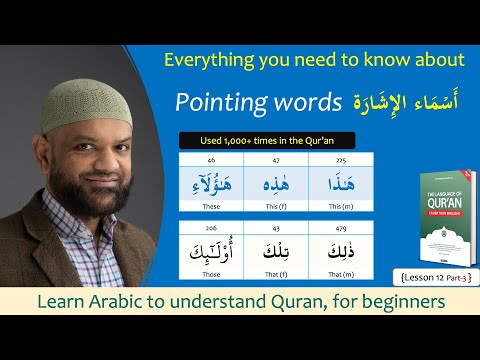 Click to play
Key Vocabulary
| Arabic | Transliteration | Meaning | Type |
|---|---|---|---|
| ضَمِيرُ الفَصْل | damirul fasl | pronoun of separation — a detached pronoun inserted between the mubtada and a definite khabar to signal that a sentence (not a phrase) is intended, and to add emphasis | grammatical term |
| هَذَا هُوَ الْعَالِمُ | haadha huwal 'aalimu | This is THE scholar (pronoun هُوَ inserted for emphasis and definiteness of khabar) | example phrase |
| أُولَئِكَ هُمُ الْمُفْلِحُونَ | ulaa'ika humul muflihuun | It is they who are the successful | Quranic phrase |
| تِلْكَ الدَّارُ الْآخِرَةُ | tilkad daarul aakhirah | That is the home of the Hereafter | Quranic phrase |
| ذَلِكَ الْفَضْلُ الْكَبِيرُ | dhalikal fadlul kabiir | That is the great bounty | Quranic phrase |
| هَذَا لِسَانٌ عَرَبِيٌّ مُّبِينٌ | haadha lisaanun 'arabiyyun mubiin | This is plain Arabic language | Quranic phrase |
| تِلْكَ آيَاتُ اللهِ | tilka aayaatullaah | Those are the ayat of Allah | Quranic phrase |
| مُبْتَدَأ | mubtada | the subject (first part) of a nominal sentence — definite and rafa | grammatical term |
| خَبَر | khabar | the predicate (second part) of a nominal sentence — rafa | grammatical term |
Introduction
This is the third and final part of Lesson 12 on demonstratives. Parts 1 and 2 built up the full picture of how pointing words work in phrases (المُرَكَّب الإِشَارِي) and sentences (الجُمْلَة الاِسْمِيَّة), including the complex cases of pointing to an idafa construct. In Part 3, we complete the topic with two new ideas — the pronoun of separation (ضَمِير الفَصْل), which allows us to say "this is THE scholar" with emphasis, and the use of far demonstratives for emphasis even when referring to something near. The lesson then concludes with seven real Quranic examples that put every structure we have learned into practice at once.
Demonstratives appear in the Quran more than 1,060 times, so finding one on every page is the norm, not the exception. By the end of this lesson, you will be able to pause at any of these occurrences and parse it completely.
The Concept
### The pronoun of separation — ضَمِير الفَصْل
In Arabic, placing a pointing word directly before a definite noun creates a demonstrative phrase, not a sentence:
> هَذَا الْعَالِمُ — "this scholar" (a phrase, not a sentence)
To say "this is the scholar" with the definite article on the khabar, we need a device to signal that a sentence is intended and to prevent the phrase reading. That device is the pronoun of separation: a detached rafa pronoun placed between the pointing word and the definite khabar.
> هَذَا هُوَ الْعَالِمُ — "This is THE scholar"
The pronoun of separation must match the noun being pointed to in number and gender. It is placed between the ismul isharah and the definite khabar. The result carries two functions: (1) it signals a complete sentence, and (2) it adds emphasis — "it is specifically this person who is THE scholar."
Choosing the correct pronoun:
| Noun type | Pronoun of separation | Example | |-----------|----------------------|---------| | Masculine singular | هُوَ | هَذَا هُوَ الْعَالِمُ | | Feminine singular | هِيَ | هَذِهِ هِيَ الْبِنْتُ | | Broken plural (non-rational) | هِيَ | هَذِهِ هِيَ الأَقْلَامُ | | Masculine plural (rational) | هُمْ | هَؤُلَاءِ هُمُ الْمُسْلِمُونَ |
Note: broken plurals of non-rational nouns are treated as singular feminine throughout, so هِيَ is the correct pronoun of separation even for masculine broken plurals (e.g., أَقْلَام — pens).
### Far demonstratives used for emphasis on what is near
Arabic (and the Quran) sometimes uses ذَلِكَ، تِلْكَ، أُولَئِكَ when referring to something that is physically near or has just been mentioned, in order to elevate its importance and create greater emphasis in the reader's mind.
When a far demonstrative (ذَلِكَ، تِلْكَ، أُولَئِكَ) is used for something contextually near, it is a rhetorical device to emphasise the subject's importance. English translators often render it as "this" to convey the full force of the meaning.
Two examples from the very beginning of the Quran:
> ذَلِكَ الْكِتَابُ لَا رَيْبَ فِيهِ (Al-Baqarah 2:2) — translated as "This is the Book" — the "far" form elevates the Quran's status. > تِلْكَ حُدُودُ اللهِ (Al-Baqarah 2:229) — "These are the limits of Allah" — تِلْكَ used for weight and solemnity.
### Complete summary of the six essential demonstratives
| | Near | Far | |--|------|-----| | Masculine singular | هَذَا | ذَلِكَ | | Feminine singular | هَذِهِ | تِلْكَ | | Plural (m. or f.) | هَؤُلَاءِ | أُولَئِكَ |
All six are mabni — they do not change for rafa, nasab, or jarr. The dual forms exist but appear only twice in the Quran; recognition is sufficient.
Quranic Evidence
The lesson analyses seven Quranic examples. Each is presented below with full parsing.
Summary
- The pronoun of separation (ضَمِير الفَصْل) is inserted between the pointing word and a definite khabar to (1) signal that the structure is a sentence and not a phrase, and (2) add emphasis to the predicate. It must match the noun being pointed to in gender and number.
- Far demonstratives for emphasis: ذَلِكَ، تِلْكَ، and أُولَئِكَ are sometimes used in the Quran to refer to something near, for rhetorical elevation. Translators often render these as "this/these" to convey the full emphasis in English.
- The six core demonstratives are all mabni. I'rab is read from the musharun ilayhi. Broken plurals of non-rational nouns always take the feminine singular pointing word (هَذِهِ، تِلْكَ) and the feminine singular pronoun of separation (هِيَ).
- Demonstratives appear over 1,060 times in the Quran. Every page will contain at least one. The structures to look for are: ismul isharah + noun with الـ (phrase), ismul isharah + indefinite noun (sentence), ismul isharah + pronoun + definite noun (sentence with separation pronoun and emphasis).
- Al-Baqarah 2:5 (أُولَئِكَ عَلَى هُدًى مِّن رَّبِّهِمْ وَأُولَئِكَ هُمُ الْمُفْلِحُونَ) is an ideal revision verse: it contains harf of jarr, ism majruur, idafa with attached pronoun, demonstrative as mubtada, and the pronoun of separation — all in two short clauses.