The Five Single-Letter Particles of Jarr
بَاء · تَاء · كَاف · لَام · وَاو — inseparable huruf of jarr with pronouns
- Identify the five single-letter huruf of jarr (بَاء، تَاء، كَاف، لَام، وَاو) and understand why they are always written attached to the following word
- Know the specific meaning and usage of each particle — oath (تَاء، وَاو), comparison (كَاف), and belonging/for (لَام) and with/by (بَاء)
- Apply لَام and بَاء correctly with both nouns and all fourteen attached pronouns
- Recognise how the hamzatul wasl disappears when لِـ attaches to a word beginning with الـ, producing لِلـ
- Understand the phonetic rules that change the pronunciation of the attached pronoun هُ depending on the vowel that precedes it
Video Lesson
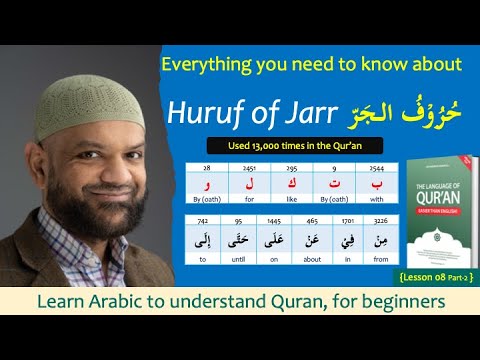 Click to play
Key Vocabulary
| Arabic | Transliteration | Meaning | Type |
|---|---|---|---|
| حَرْفُ الجَرّ | harful jarr | particle of jarr (preposition that puts the following noun into the jarr case) | grammatical term |
| بَاء | baa | by / with / in (also used for oath — billāhi) | harf of jarr |
| تَاء | taa | by (oath — used exclusively with the word Allah, 9 times in Quran) | harf of jarr |
| كَاف | kaaf | like / as (comparison) | harf of jarr |
| لَام | laam | for / belonging to | harf of jarr |
| وَاو | waaw | by (oath — used with Allah or anything else sworn by) | harf of jarr |
| مَجْرُور | majruur | a noun in the jarr (genitive) case | grammatical term |
| مُرَكَّب جَارِّي | murakkab jaarri | the jarr-majruur construct (preposition + noun in jarr) | grammatical term |
| تَاللهِ | tallaahi | by Allah (oath with تَاء) | example phrase |
| وَاللهِ | wallaahi | by Allah (oath with وَاو) | example phrase |
| لِي | lii | for me / belonging to me (لَام + first-person pronoun) | example phrase |
| بِسْمِ اللهِ | bismillaah | in the name of Allah | example phrase |
Introduction
In Part 1 of Lesson 8, we were introduced to the concept of huruf of jarr and studied مِن in depth. Now in Part 2, we move to the five huruf of jarr that are single-letter words: بَاء، تَاء، كَاف، لَام، وَاو. Because they consist of a single letter, they cannot stand alone — they are always written attached to the word that follows them. This is a feature of Arabic writing that catches beginners off guard: what looks like one word in the Quranic text is often a preposition fused onto a noun.
The teacher organises all huruf of jarr into two groups: inseparable (single-letter, written attached to the next word) and separable (multi-letter, written as separate words). This lesson covers the inseparable group. Lesson 9 will complete the study by covering مِن، فِي، عَن، عَلى، حَتَّى، إِلَى — after which students will know every harf of jarr used in the Quran, words that appear nearly 13,000 times in total.
The Concept
### The five inseparable huruf of jarr at a glance
| Harf | Core meaning | Quranic frequency | Attaches to pronouns? | |------|-------------|-------------------|-----------------------| | بَاء | by / with / in (also oath) | ~2,544 times | Yes | | تَاء | by (oath only, with Allah) | 9 times | No | | كَاف | like / as (comparison) | ~295 times | No | | لَام | for / belonging to | ~2,451 times | Yes | | وَاو | by (oath) | ~28 times as harf of jarr | No |
Every harf of jarr — whether single-letter or multi-letter — puts the ism that follows it into the jarr (majruur) case. This principle never changes.
### تَاء — oath by Allah only
تَاء is the most restricted particle. It is used only when swearing by Allah, and it appears exactly nine times in the entire Quran. The noun اللهِ that follows it is always majruur.
> تَاللهِ — "By Allah" (e.g., تَاللهِ لَقَدْ كُنَّا لَفِي ضَلَالٍ مُّبِينٍ — "By Allah, we were indeed in manifest error")
### وَاو — oath by anything
وَاو is also used for taking an oath, but far more flexibly. Allah swears by time, the morning light, the Quran, the sun, and the moon using this particle. It appears about 28 times in the Quran as a harf of jarr (and thousands of times as the conjunction "and").
When وَاو is a harf of jarr (oath), the ism after it is majruur. When it is the conjunction "and", the following noun keeps its own i'rab. Look at the kasra ending on the noun to identify the oath usage.
Examples of divine oaths in the Quran: وَالعَصْرِ (by time), وَالضُّحَى (by the morning light), وَالقُرْآنِ الحَكِيمِ (by the wise Quran).
### كَاف — comparison
كَاف means "like" or "as" and is used purely for comparisons. It does not attach to pronouns. When it joins a word beginning with الـ, the hamzatul wasl is present in writing but dropped in reading — producing a compound that looks like one word.
> كَالفُجَّارِ — "like the wicked" > كَالفَرَاشِ المَبْثُوثِ — "like scattered moths" (Al-Qari'ah, 101:4)
Note: when كَاف precedes a descriptive phrase (مُرَكَّب تَوْصِيفِي), the adjective copies the jarr of the noun it describes — for example, كَالفَرَاشِ المَبْثُوثِ, where مَبْثُوثِ is jarr because it copies from فَرَاشِ.
### لَام — for / belonging to
لَام has two written forms depending on what follows:
- لِـ — used before any regular noun: لِطَالِبٍ (for a student)
- لَـ — used before attached pronouns: لَهُ (for him / belonging to him)
When لِـ is added before a word beginning with الـ, the hamzatul wasl is not written. The result is لِلـ: لِلْكِتَابِ (for the book), لِلْمُتَّقِينَ (for the pious). With the word اللهِ specifically, the two laam letters merge in writing: لِلَّهِ.
لَام with the fourteen attached pronouns
When لَام attaches to an attached pronoun, the vowel on the laam changes from kasra to fatha (لَـ). There is one important exception: the first-person singular يَاء always requires a kasra before it, so instead of لَايَ the form contracts to لِي.
| Form | Meaning | |------|---------| | لَهُ | for him | | لَهَا | for her | | لَهُم | for them (m. pl.) | | لَهُنَّ | for them (f. pl.) | | لَكَ | for you (m. sg.) | | لَكُم | for you (m. pl.) | | لَكِ | for you (f. sg.) | | لَكُنَّ | for you (f. pl.) | | لِي | for me | | لَنَا | for us |
لَهُ appears very frequently in the Quran — for example: لَهُ مُلْكُ السَّمَاوَاتِ وَالأَرْضِ (to Him belongs the kingdom of the heavens and the earth).
### بَاء — with / by / in
بَاء is one of the most commonly occurring words in the Quran (2,544 times). Its meanings range from "with" and "in" to "by" when used for oath (بِاللهِ — by Allah). Its most famous occurrence is at the opening of every surah: بِسْمِ اللهِ الرَّحْمَنِ الرَّحِيمِ.
Unlike تَاء، كَاف، and وَاو, بَاء attaches freely to both nouns and all fourteen attached pronouns.
Phonetic rule for هُ when preceded by بِـ
The attached pronoun هُ (him/his) changes its vowel depending on what immediately precedes it:
- Preceded by a fatha or dhamma → read with elongation: لَهُو → لَهُ, رَسُولُهُو → رَسُولُهُ
- Preceded by a kasra or a sukuun on يَاء → the هُ shortens to هِ: بِهِ (not بِهُ)
When يَاء ساكِن or a kasra immediately precedes هُم/هُمَا/هُنَّ, they become هِم/هِمَا/هِنَّ for phonetic reasons: بِهِم، عَلَيْهِم، إِلَيْهِم. This pattern repeats throughout the Quran.
Quranic Evidence
Summary
- The five inseparable huruf of jarr — بَاء، تَاء، كَاف، لَام، وَاو — are single letters always written attached to the word that follows. What appears as one word in Quranic text is often a preposition fused with a noun.
- تَاء is restricted to oath by Allah only (9 times in Quran). وَاو takes oath by Allah or any phenomenon Allah swears by (~28 times as harf of jarr). كَاف means "like/as" (comparison, ~295 times) and does not attach to pronouns.
- لَام (~2,451 times) has two forms: لِـ before nouns and لَـ before attached pronouns — with the exception of لِي for the first-person singular. Before words beginning with الـ, the hamzatul wasl disappears, giving لِلـ.
- بَاء (~2,544 times) is the most versatile: it means "with/by/in" and attaches to both nouns and all fourteen attached pronouns. It is visible from the very first word of every surah in بِسْمِ اللهِ.
- When هُ (and هُم، هُمَا، هُنَّ) is preceded by a kasra or يَاء ساكِن, it shifts to هِ/هِم/هِمَا/هِنَّ for phonetic reasons — a pattern that recurs constantly throughout the Quran in forms like بِهِم and عَلَيْهِم.