Negate Jumlah Ismiyyah
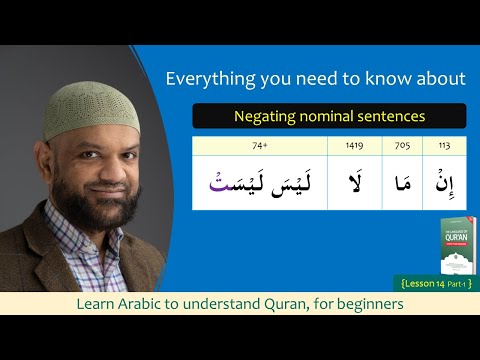
Laysa · Mā · Lā · Double Negation
- Negate a jumlah ismiyyah (nominal sentence) using لَيْسَ (laysa)
- Recognise that laysa is a verb with masculine (laysa) and feminine (laysат) forms
- Apply مَا (mā) and لَا (lā) as particles of negation that behave like laysa
- Identify ismu laysa (rafa') and khabaru laysa (nasab) in a negated sentence
- Use double and triple negation patterns with مَا...وَلَا and لَا...وَلَا...لَا
- Recognise common Quranic examples of negated nominal sentences
Video Lesson
 Click to play
Key Vocabulary
| Arabic | Transliteration | Meaning | Type |
|---|---|---|---|
| لَيْسَ | laysa | is not (masculine) — negating verb | FIL |
| لَيْسَتْ | laysat | is not (feminine) — negating verb | FIL |
| مَا | mā | not — particle of negation (no gender distinction) | HARF |
| لَا | lā | no / not — particle of negation, mainly with indefinite subjects | HARF |
| اِسْمُ لَيْسَ | ismu laysa | subject of laysa, remains in rafa' | ISM |
| خَبَرُ لَيْسَ | khabaru laysa | predicate of laysa, converted to nasab | ISM |
| دَافِعٌ | dāfi` | preventer / repeller | ISM |
| خَوْفٌ | khawf | fear | ISM |
Introduction
In previous lessons we learned to form and emphasise the nominal sentence (الجُمْلَةُ الاسْمِيَّةُ). In this lesson we learn how to negate it using three tools: لَيْسَ (a verb), and مَا and لَا (particles). Each tool converts the sentence to a negative meaning while the predicate (الخَبَر) shifts to nasab (accusative) case.
The Concept
### Review: Jumlah Ismiyyah Structure
A nominal sentence has two parts, both in rafa' by default:
| Part | Arabic | Function | I'rab | |------|--------|----------|-------| | Subject | زَيْدٌ | مُبْتَدَأ (mubtada') | رَفْع | | Predicate | عَالِمٌ | خَبَر (khabar) | رَفْع |
زَيْدٌ عَالِمٌ — Zayd is a scholar.
Key reminder: when the subject is indefinite, a jar-majroor or adverbial (zarf) predicate comes first. Jar-majroor and zarf phrases can never serve as mubtada'.
### Negation with لَيْسَ (Laysa)
لَيْسَ is a verb that negates the nominal sentence. It:
- Adds the meaning "not" to the sentence
- Converts the khabar into nasab
The subject is now called اِسْمُ لَيْسَ (ismu laysa) — remains rafa'. The predicate is now called خَبَرُ لَيْسَ (khabaru laysa) — becomes nasab.
| Positive | Negative | |---------|----------| | زَيْدٌ عَالِمٌ — Zayd is a scholar | لَيْسَ زَيْدٌ عَالِمًا — Zayd is not a scholar | | زَيْنَبُ ذَكِيَّةٌ — Zaynab is clever | لَيْسَتْ زَيْنَبُ ذَكِيَّةً — Zaynab is not clever |
Because لَيْسَ is a verb it requires gender agreement:
- لَيْسَ — used when the subject is masculine
- لَيْسَتْ — used when the subject is feminine
لَيْسَ appears 74 times in the Quran; لَيْسَتْ 3 times.
### Negation with مَا (Mā)
مَا is a particle that behaves exactly like لَيْسَ grammatically — it converts the khabar to nasab. Because it is a particle (not a verb), there is no masculine/feminine distinction.
مَا زَيْدٌ عَالِمًا — Zayd is not a scholar.
Other uses of مَا in Arabic:
- Negation of past-tense verbs
- Relative pronoun ("that which")
- Question word (مَا هَذَا — what is this?)
مَا is used 705 times as a particle of negation in the Quran.
### Negation with لَا (Lā)
لَا is a particle that also negates like laysa, but is primarily used when the subject is indefinite.
لَا خَوْفٌ عَلَيْهِمْ — There is no fear upon them. (خَوْفٌ is indefinite)
لَا is used 1419 times as a particle of negation in the Quran.
### Double and Triple Negation
Arabic negates two or three things in one structure by combining مَا and لَا or repeating لَا:
| Pattern | Example | Meaning | |---------|---------|---------| | مَا...وَلَا | مَا عِنْدِي قَلَمٌ وَلَا كِتَابٌ | I have neither a pen nor a book | | لَا...وَلَا | لَا خَوْفٌ عَلَيْهِمْ وَلَا هُمْ يَحْزَنُونَ | No fear upon them, nor will they grieve | | لَا...لَا...لَا | لَا بَيْعٌ... وَلَا خُلَّةٌ... وَلَا شَفَاعَةٌ | No exchange, no friendship, no intercession |
Quranic Evidence
Analysis: لَيْسَ = negating verb | كَمِثْلِهِ = jar-majroor (khabar, coming first because subject is indefinite) | شَيْءٌ = ismu laysa in rafa'.
Analysis: لَا negates the indefinite noun خَوْفٌ; وَلَا continues the negation — classic double negation pattern.
Summary
- لَيْسَ (verb): negates nominal sentences; gender agreement required (laysa / laysат); khabar becomes nasab (خَبَرُ لَيْسَ); subject stays rafa' (اِسْمُ لَيْسَ)
- مَا (particle): same grammatical effect as laysa; no gender distinction; 705x in Quran as negation; also used as relative pronoun and question word
- لَا (particle): primarily with indefinite subjects; 1419x in Quran; main particle for negating the imperfect verb (al-mudari')
- Double negation: مَا...وَلَا or لَا...وَلَا; triple negation: لَا...لَا...لَا
- When jar-majroor or zarf is the predicate, the indefinite subject follows — no visible nasab change on the subject itself