The Six Separable Huruf of Jarr
Min, Fi, An, Ala, Hatta, Ila — with Attached Pronouns
- Identify and name the six separable huruf of jarr used in the Quran
- Distinguish between inseparable single-letter huruf of jarr and the separable six
- Recognise each harf of jarr in Quranic text by written form and pronunciation
- Attach all 14 pronouns to min and fi and reproduce the conjugation tables from memory
- Explain why attached pronouns must be used — not detached pronouns — after a harf of jarr
- Memorise one Quranic or Islamic phrase as a mnemonic anchor for each of the six huruf of jarr
Video Lesson
 Click to play
Key Vocabulary
| Arabic | Transliteration | Meaning | Type |
|---|---|---|---|
| حَرْفُ جَرٍّ | harf jarr | preposition — a particle that places the following noun or pronoun in the genitive (jarr) case | HARF |
| مِنْ | min | from, of, among | HARF |
| فِي | fii | in, at, on | HARF |
| عَنْ | `an | about, from, away from, on behalf of | HARF |
| عَلَى | `alaa | on, upon, over | HARF |
| حَتَّى | hattaa | until, even, so that | HARF |
| إِلَى | ilaa | to, towards, until | HARF |
| مَجْرُورٌ | majruur | a noun in the genitive (jarr) case | ISM |
| مُنْفَصِلٌ | munfasil | separable — written as an independent word, not joined to the following word | ISM |
| نُونُ الْوِقَايَةِ | nuun al-wiqaayah | the protective noon — an extra noon inserted before the first-person yaa' to ease pronunciation | ISM |
Introduction
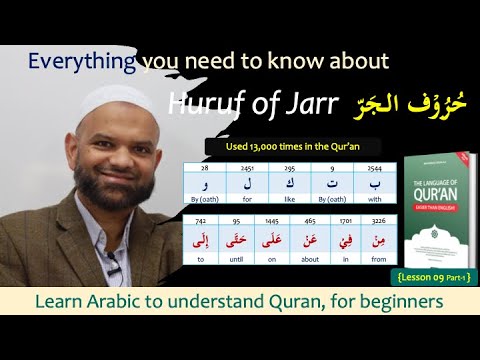
In Lesson 8 we studied the five single-letter huruf of jarr — بِ، تَ، كَ، لِ، وَ — which are always written attached (joined) to the word that follows them. In this lesson we turn to the remaining six huruf of jarr found in the Quran. Unlike the single-letter group, these six are written as independent words and are therefore called separable (مُنْفَصِل).
Together, the eleven huruf of jarr used in the Quran appear approximately 13,000 times — on average, at least one in every line of the standard mus-haf. By the end of this lesson a student who opens any page of the Quran should be able to find and recognise something in every single line.
The six separable huruf of jarr, with their core meanings and approximate Quranic frequencies:
| Harf | Transliteration | Core meaning | Frequency | |------|----------------|--------------|-----------| | مِنْ | min | from, of, among | ~3,226 | | فِي | fii | in, at | ~1,700 | | عَنْ | an | about, from, away from | ~465 | | عَلَى | alaa | on, upon | ~1,445 | | حَتَّى | hattaa | until, even | ~95 | | إِلَى | ilaa | to, towards | ~742 |
A learning strategy taught throughout this lesson: never learn a word in isolation. Link each harf of jarr to a Quranic phrase or Islamic expression you already know and use daily. A word anchored to something familiar enters long-term memory far more reliably than a bare definition repeated in isolation.
The Concept
### Separable vs. Inseparable Huruf of Jarr
Single-letter huruf of jarr (بِ، تَ، كَ، لِ، وَ) are always written joined to the word that follows them. The six separable huruf of jarr (مِنْ، فِي، عَنْ، عَلَى، حَتَّى، إِلَى) are written as independent words. A single-letter prefix such as فَ may attach to their front — but they themselves do not attach to the noun or pronoun that follows.
When reading the Quran, what appears at first glance to be one long word is often two, three or even four distinct units. For example, فَمِنْهُمْ contains three words: فَ (so / thus) + مِنْ (from) + هُمْ (them). Learning to see these internal boundaries is the foundation of Quranic reading comprehension.
### The Effect of a Harf of Jarr on the Following Noun
Every harf of jarr forces the noun immediately after it into the jarr (genitive) case. That noun will take a kasrah ending — or, for nouns that do not take tanween (ghayru munsarif), a fathah serves as the jarr marker. The harf and the noun it governs together form a مُرَكَّبٌ جَارِّيٌّ (murakkab jarii), a prepositional phrase.
### Attaching Pronouns to Huruf of Jarr
The detached pronouns (هُوَ، هِيَ، أَنَا, etc.) are fixed in the rafa' case and cannot serve as the object of a harf of jarr. For that function Arabic uses the attached pronouns (الضَّمَائِرُ الْمُتَّصِلَة), which suffix directly onto the harf of jarr and are always majruur in this position.
After a harf of jarr, a pronoun must be expressed as an attached (suffixed) pronoun — never as a detached pronoun. The attached pronoun is then the ism majruur of the prepositional phrase.
مِنْ with attached pronouns:
| Person | Form | Meaning | |--------|------|---------| | 3rd m. sg. | مِنْهُ | from him | | 3rd m. du. | مِنْهُمَا | from them two | | 3rd m. pl. | مِنْهُمْ | from them | | 3rd f. sg. | مِنْهَا | from her | | 3rd f. du. | مِنْهُمَا | from them two (f.) | | 3rd f. pl. | مِنْهُنَّ | from them (f.) | | 2nd m. sg. | مِنْكَ | from you | | 2nd m. du. | مِنْكُمَا | from you two | | 2nd m. pl. | مِنْكُمْ | from you all | | 2nd f. sg. | مِنْكِ | from you (f.) | | 2nd f. du. | مِنْكُمَا | from you two (f.) | | 2nd f. pl. | مِنْكُنَّ | from you all (f.) | | 1st sg. | مِنِّي | from me | | 1st pl. | مِنَّا | from us |
The نُونُ الْوِقَايَة (Protective Noon): When مِنْ attaches to the first-person pronoun يَاء, an extra noon is inserted, producing مِنِّي. This noon is called the protective noon (nuun al-wiqaayah). It stands between the word and the يَاء that always demands a kasrah before it, protecting مِنْ from being altered. The two noons produce a shadda: مِنِّي. Similarly, مِنَّا (from us) shows two noons — the noon of مِنْ and the noon of نَا — merging with a shadda.
Key phonological changes when attaching pronouns to فِي:
The ya' at the end of فِي affects what follows it. When the attached pronoun هُ comes after ya'-sukuun, it shifts from هُ to هِ — hence فِيهِ (not فِيهُ). When the first-person يَاء attaches, the two ya's merge with a shadda: فِيَّ. All other pronouns follow the same pattern as مِنْ.
### Mnemonic Anchors for the Six Huruf of Jarr
| Harf | Mnemonic phrase | Meaning | |------|----------------|---------| | مِنْ | أَعُوذُ بِاللهِ مِنَ الشَّيْطَانِ الرَّجِيمِ | I seek refuge with Allah from Shaytan the outcast | | فِي | فِي سَبِيلِ اللهِ | in the path of Allah | | عَنْ | رَضِيَ اللهُ عَنْهُ | may Allah be pleased with him | | عَلَى | اَلسَّلَامُ عَلَيْكُمْ | peace be upon you | | حَتَّى | سَلَامٌ هِيَ حَتَّى مَطْلَعِ الْفَجْرِ | it is peace until the break of dawn | | إِلَى | فَفِرُّوا إِلَى اللهِ | so flee to Allah |
Quranic Evidence
Summary
This lesson covered the six separable huruf of jarr that account for the vast majority of the ~13,000 prepositional constructs in the Quran:
- مِنْ (from) — the single most frequent word in the Quran, ~3,226 occurrences
- فِي (in, at) — ~1,700 occurrences
- عَنْ (from, about) — ~465 occurrences
- عَلَى (on, upon) — ~1,445 occurrences
- حَتَّى (until) — ~95 occurrences; its use before verbs is an advanced topic
- إِلَى (to, towards) — ~742 occurrences
Every harf of jarr places the noun or pronoun that follows it in the jarr (genitive) case. When a pronoun is needed after a harf of jarr, only an attached pronoun may be used — a detached pronoun is grammatically impossible. The first-person singular attached pronoun triggers the insertion of نُونُ الْوِقَايَة, producing forms like مِنِّي and عَنِّي.
Learners who master the full مِنْ conjugation table will find that the tables for فِي، عَنْ، عَلَى، and إِلَى follow the same pattern with only minor phonological adjustments.