Demonstratives — I'rab, Idafa, and the Jumla Ismiyya
i'rab of murakkab ishaari · pointing to mudaf or mudaf ilayhi · demonstratives in sentences
- Identify the i'rab (grammatical case) of a demonstrative phrase by looking at the musharun ilayhi, since the ismul isharah itself is mabni and does not change
- Correctly form demonstrative phrases in rafa, nasab, and jarr for both singular and plural nouns
- Point to the mudaf or the mudaf ilayhi within an idafa construct using the correct placement of the ismul isharah
- Use demonstrative words as the mubtada of a jumla ismiyya and supply an appropriate khabar
- Understand when the khabar in a jumla ismiyya can be definite, and recognise the role of the pronoun of separation (to be developed further in Part 3)
Video Lesson
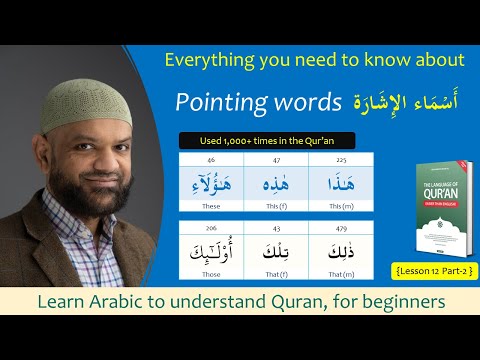 Click to play
Key Vocabulary
| Arabic | Transliteration | Meaning | Type |
|---|---|---|---|
| اِسْمُ الإِشَارَة | ismul isharah | demonstrative pronoun (pointing word) | grammatical term |
| مُشَارٌ إِلَيْهِ | musharun ilayhi | the noun being pointed to | grammatical term |
| مَبْنِي | mabni | indeclinable — a word whose ending does not change regardless of its grammatical role | grammatical term |
| هَذَا | haadha | this (m. sg., near) | demonstrative |
| هَذِهِ | haadhihi | this (f. sg., near) | demonstrative |
| هَؤُلَاء | haa'ulaa'i | these (pl., near — used for both masculine and feminine) | demonstrative |
| ذَلِكَ | dhaalika | that (m. sg., far) | demonstrative |
| تِلْكَ | tilka | that (f. sg. or broken plural, far) | demonstrative |
| أُولَئِكَ | ulaa'ika | those (pl., far — used for both masculine and feminine) | demonstrative |
| مُرَكَّب إِشَارِي | murakkab ishaari | demonstrative phrase (pointing word + noun with الـ) | grammatical term |
| مُضَاف | mudaf | the first element of an idafa construct (the "owner" or "of" word) | grammatical term |
| مُضَافٌ إِلَيْهِ | mudaf ilayhi | the second element of an idafa construct — always majruur | grammatical term |
Introduction
Lesson 12 Part 1 introduced the six essential demonstrative pronouns (أَسْمَاء الإِشَارَة) and the basic demonstrative phrase (مُرَكَّب إِشَارِي). In Part 2, we go deeper: we work out the i'rab of demonstrative phrases, explore the tricky problem of pointing to an idafa construct, and use demonstratives as the subject of a nominal sentence (جُمْلَة اِسْمِيَّة). These are precisely the structures that appear in every page of the Quran, so mastering them here pays direct dividends when reading the Quranic text.
A key principle runs throughout this lesson: the pointing word itself (هَذَا، هَذِهِ، هَؤُلَاء etc.) is mabni — its ending never changes. We can therefore only read the i'rab from the noun being pointed to (مُشَارٌ إِلَيْهِ).
The Concept
### Reading the i'rab of a demonstrative phrase
Because the ismul isharah is mabni and cannot show i'rab through its own ending, the grammatical case of the whole phrase is revealed by the musharun ilayhi — the noun with الـ that follows the pointing word.
The musharun ilayhi copies the i'rab of the ismul isharah. Since the ismul isharah is mabni, we determine the case from the role the phrase plays in the sentence and then confirm it by reading the ending of the musharun ilayhi.
Three examples with the same noun هَذَا المَسْجِدُ:
| Structure | Arabic | Case | Role | |-----------|--------|------|------| | Rafa | هَذَا الْمَسْجِدُ | marfu | mubtada or fa'il | | Nasab | هَذَا الْمَسْجِدَ | mansub | maf'ul bih (object) | | Jarr | فِي هَذَا الْمَسْجِدِ | majruur | after harf of jarr |
> رَأَيْتُ هَذَا الْمَسْجِدَ — "I saw this mosque" (nasab, because it is the object) > صَلَّيْتُ فِي هَذَا الْمَسْجِدِ — "I prayed in this mosque" (jarr, because it follows فِي)
### Pointing to an idafa construct
The idafa (مُرَكَّب إِضَافِي) has two parts: mudaf and mudaf ilayhi. When we want to point to one of them, the placement of the ismul isharah changes:
Pointing to the mudaf (e.g., "this house of the teacher"):
The mudaf cannot take الـ (a rule of idafa), so we cannot put هَذَا in front with الـ on the mudaf — that would break the idafa. Instead, the pointing word must come after the entire idafa construct:
When pointing to the mudaf, place the ismul isharah at the END of the idafa construct: بَيْتُ الْمُعَلِّمِ هَذَا — "this house of the teacher"
> بَيْتُ الْمُعَلِّمِ هَذَا — this house of the teacher (هَذَا points back to بَيْتُ) > سَيَّارَةُ زَيْدٍ هَذِهِ — this car of Zaid (هَذِهِ points to سَيَّارَةُ, which is feminine)
Note: if هَذَا is placed in front of an idafa construct, the result is a complete sentence (jumla ismiyya), not a phrase: هَذَا بَيْتُ الْمُعَلِّمِ = "This is the teacher's house."
Pointing to the mudaf ilayhi (e.g., "the house of this teacher"):
This is straightforward. The ismul isharah and musharun ilayhi form a murakkab ishaari that itself becomes the mudaf ilayhi:
> بَيْتُ هَذَا الْمُعَلِّمِ — "the house of this teacher" (هَذَا الْمُعَلِّمِ is the murakkab ishaari serving as mudaf ilayhi) > كِتَابُ هَذِهِ الْمُعَلِّمَةِ — "the book of this (female) teacher"
### Demonstratives in the jumla ismiyya (nominal sentence)
Demonstratives are very commonly used as the mubtada (subject) of a jumla ismiyya. The rules are exactly as before: mubtada is rafa and definite, khabar is rafa and (usually) indefinite.
> هَذَا مُسْلِمٌ — "This is a Muslim" (hatha = mubtada, muslimun = khabar, indefinite) > هَؤُلَاءِ مُسْلِمُونَ — "These are Muslims" > تِلْكَ مَدَارِسُ — "Those are schools" (broken plural treated as feminine singular → tilka)
When the khabar can be definite
Normally the khabar is indefinite, but there are two situations where a definite khabar is permitted:
- When the mubtada is a detached rafa pronoun (هُوَ، هِيَ etc.) and the khabar is a proper noun or begins with الـ:
> هُوَ حَامِدٌ — "He is Hamid" / هِيَ الطَّالِبَةُ — "She is the student"
- When the mubtada is a pointing word and the khabar is a proper noun:
> هَذَا حَامِدٌ — "This is Hamid" > ذَلِكَ عِيسَى — "That is Isa" (from the Quran, Al-Imran, 3:59)
A murakkab ishaari (pointing word + noun with الـ) is a PHRASE, not a sentence. A jumla ismiyya with a pointing word as mubtada requires the khabar to be indefinite — unless the khabar is a proper noun (in which case it can be definite).
Distinguishing a murakkab ishaari from a jumla ismiyya
| Structure | Example | Analysis | |-----------|---------|---------| | Demonstrative phrase (murakkab ishaari) | هَذَا الْوَلَدُ | phrase — "this boy" | | Complete sentence (jumla ismiyya) | هَذَا وَلَدٌ | sentence — "this is a boy" | | Demonstrative phrase as mubtada | هَذَا الْكِتَابُ جَدِيدٌ | mubtada (phrase) + khabar — "this book is new" |
The signal is simple: after the pointing word, if there is a word with الـ and no further predicate, it is a phrase. If there is no الـ, or if there is additional information after the phrase, it is (or contains) a sentence.
### Broken plurals and demonstratives
Broken plurals of non-rational nouns (غَيْرُ عَاقِل) are treated as singular feminine throughout Arabic grammar. This rule applies equally to demonstratives:
> هَذِهِ أَبْوَابٌ — "These are doors" (أَبْوَاب is a broken plural of a non-rational noun → هَذِهِ, not هَؤُلَاء) > تِلْكَ مَسَاجِدُ — "Those are mosques" (broken plural, feminine → تِلْكَ) > تِلْكَ مَدَارِسُ — "Those are schools" (same rule)
Quranic Evidence
Summary
- The ismul isharah (pointing word) is mabni — it does not change its ending regardless of the grammatical case. The i'rab is shown by the musharun ilayhi (the noun being pointed to), which copies the case of the pointing word.
- When pointing to the mudaf of an idafa construct, the ismul isharah must come after the entire idafa (e.g., بَيْتُ الْمُعَلِّمِ هَذَا). Placing it before the idafa produces a complete sentence instead of a phrase.
- When pointing to the mudaf ilayhi, simply build the murakkab ishaari and use it as the mudaf ilayhi (e.g., بَيْتُ هَذَا الْمُعَلِّمِ).
- Broken plurals of non-rational nouns are treated as singular feminine — so use هَذِهِ and تِلْكَ with words like مَسَاجِدُ, كُتُبٌ, and مَدَارِسُ.
- In a jumla ismiyya, the khabar is normally indefinite. It can be definite only when the mubtada is a rafa pronoun or a pointing word and the khabar is a proper noun (e.g., هَذَا حَامِدٌ، ذَلِكَ عِيسَى).