إنَّ and Her Sisters — إنَّ وَأَخَوَاتُهَا
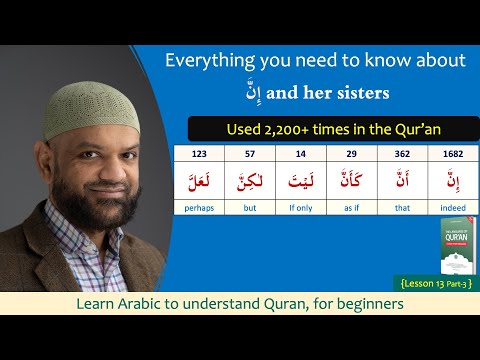
أنَّ · كَأنَّ · لَيْتَ · لَكِنَّ · لَعَلَّ · noon of protection · Quranic examples
- Name all six sisters of إنَّ with their meanings and Quranic frequency
- Distinguish أنَّ from إنَّ by their position in the sentence
- Understand كَأنَّ as a particle of comparison and apply it to Quranic examples
- Recognise لَيْتَ as a particle of wishing and لَكِنَّ as a particle of contrast
- Understand the three meanings of لَعَلَّ (hope, apprehension, purpose) and identify them in context
Video Lesson
 Click to play
Key Vocabulary
| Arabic | Transliteration | Meaning | Type |
|---|---|---|---|
| إِنَّ وَأَخَوَاتُهَا | inna wa akhawaatuha | Inna and her sisters — the six particles that share the same grammatical rule | grammatical category |
| الْحُرُوفُ الْمُشَبَّهَةُ بِالْفِعْلِ | alhurooful-mushabbaha bil-fi'l | particles resembling the verb — the formal Arabic name for إنَّ and her sisters | grammatical term |
| أَنَّ | anna | that / verily (always mid-sentence) | harf of nasab |
| كَأَنَّ | ka-anna | as if / as though (comparison) | harf of nasab |
| لَيْتَ | layta | if only / I wish (expressing a wish or longing) | harf of nasab |
| لَكِنَّ | lakinna | but / however / on the contrary (contrast and rectification) | harf of nasab |
| لَعَلَّ | la-alla | perhaps / hopefully / maybe (hope, apprehension, or purpose) | harf of nasab |
| نُونُ الوِقَايَة | noonul-wiqaya | noon of protection — inserted before ya mutakallim | grammatical term |
| يَا لَيْتَنِي | ya laytanii | woe to me / if only I had | expression of regret (Quranic phrase) |
Introduction
In Parts 1 and 2 we explored إنَّ in depth — how it works, how to attach pronouns to it, and how to combine it with the lam of emphasis and إنَّمَا. Part 3 completes the picture by introducing the remaining five sisters: أَنَّ، كَأَنَّ، لَيْتَ، لَكِنَّ، لَعَلَّ.
Together, these six particles appear over 2,200 times in the Quran — on average three or four times every page of the standard Mus-haf. They are known collectively as إنَّ وَأَخَوَاتُهَا (Inna and her sisters), or in the classical grammar books as الْحُرُوفُ الْمُشَبَّهَةُ بِالْفِعْلِ (particles resembling the verb) — because like a verb, they take their ism into nasab. All six share the same grammatical rule. What distinguishes them is meaning and position.
The Concept
### The Rule Common to All Six Sisters
All six particles — إنَّ، أنَّ، كَأنَّ، لَيْتَ، لَكِنَّ، لَعَلَّ — share the same grammatical effect: [Ism of the particle: nasab] + [Khabar of the particle: rafa] Learn the rule once for إنَّ and you have learned it for all six.
### أَنَّ — That / Verily (Mid-Sentence)
أَنَّ is grammatically identical to إنَّ — same impact, same meaning of assertion. The crucial difference is position in the sentence:
- إنَّ always comes at the beginning of its clause.
- أَنَّ always comes in the middle — it can never open a sentence.
أَنَّ typically follows a verb such as عَلِمَ (to know), شَهِدَ (to bear witness), or أَشْهَدُ (I bear witness):
> أَشْهَدُ أَنَّ مُحَمَّدًا رَسُولُ اللهِ — I bear witness that Muhammad is the messenger of Allah.
Here, أَشْهَدُ (a verb) has come first, so we use أَنَّ not إنَّ. مُحَمَّدًا is the ism of أَنَّ (nasab) and رَسُولُ اللهِ is the khabar (rafa — mudaf-mudaf ilayhi structure).
One important exception: after the verb قَالَ (he said) and its derivatives, إنَّ may appear in the middle — this is not أَنَّ but إنَّ in a rare permitted position.
إنَّ = beginning of clause أَنَّ = middle of clause (after a verb like عَلِمَ، شَهِدَ، قَالَ etc.)
أَنَّ is used 362 times in the Quran.
### كَأَنَّ — As If / As Though (Comparison)
كَأَنَّ expresses comparison — like saying "he is like a lion" or "it is as if they were eggs." It is formed from كَ (the particle of comparison, meaning like) + أَنَّ. It makes its ism nasab and leaves its khabar in rafa, exactly like إنَّ.
> كَأَنَّ زَيْدًا أَسَدٌ — It is as if Zayd is a lion (he is very brave).
كَأَنَّ is used 29 times in the Quran.
### لَيْتَ — If Only / I Wish (Expressing a Wish)
لَيْتَ is the particle of wish or longing. It is used to express something the speaker desires — whether that wish is attainable or not. It carries the same grammatical rule: its ism takes nasab and its khabar stays in rafa.
> لَيْتَ الإِسْلَامَ غَالِبٌ — If only Islam were victorious.
لَيْتَ is used 14 times in the Quran but appears frequently across all classical Arabic texts.
Note on the noon of protection with لَيْتَ: When attaching the ya mutakallim (I) to لَيْتَ, the noon of protection is required — لَيْتَنِي is the only option (لَيْتِي is not used). This is the opposite of لَعَلَّ where the noon of protection is not permitted.
### لَكِنَّ — But / However (Contrast)
لَكِنَّ is the particle of contrast and correction. It introduces a statement that is contrary to or qualifies what came before. In English it conveys: but, however, or on the contrary.
> الرَّجُلُ غَنِيٌّ لَكِنَّهُ بَخِيلٌ — The man is rich; however, he is a miser.
Here لَكِنَّهُ = لَكِنَّ + هُ (attached pronoun as its ism in nasab), and بَخِيلٌ is the khabar (rafa).
لَكِنَّ is used 65 times in the Quran.
### لَعَلَّ — Perhaps / Hopefully / Maybe (Hope, Apprehension, Purpose)
لَعَلَّ has three possible shades of meaning depending on context:
- Hope — perhaps something good will happen: hopefully Zayd is well.
- Apprehension / fear — perhaps something unwanted may happen: perhaps he is ill.
- Purpose — so that / in order that.
The meaning is determined by context. The grammatical rule is unchanged.
> لَعَلَّ السَّاعَةَ قَرِيبٌ — Perhaps the Hour is near.
لَعَلَّ is used 129 times in the Quran.
Note on the noon of protection with لَعَلَّ: The noon of protection is not permitted with لَعَلَّ. Only لَعَلِّي is possible (not لَعَلَّنِي).
### The Noon of Protection — Summary for All Six
| Particle | Noon of Protection | |----------|--------------------| | إنَّ | Optional — both إِنِّي and إِنَّنِي are used | | أَنَّ | Optional — both أَنِّي and أَنَّنِي are used | | كَأَنَّ | Optional — both كَأَنِّي and كَأَنَّنِي are used | | لَكِنَّ | Optional — both لَكِنِّي and لَكِنَّنِي are used | | لَيْتَ | Required — only لَيْتَنِي is used | | لَعَلَّ | Not permitted — only لَعَلِّي is used |
Quranic Evidence
Summary
- All six sisters of إنَّ — إنَّ، أنَّ، كَأنَّ، لَيْتَ، لَكِنَّ، لَعَلَّ — share the same grammatical rule: ism in nasab, khabar in rafa.
- أنَّ is identical to إنَّ in grammar but always appears mid-sentence (after verbs like عَلِمَ and أَشْهَدُ). إنَّ always opens its clause.
- كَأنَّ is used for comparison ("as if / as though") and appears 29 times in the Quran.
- لَيْتَ expresses a wish or longing and requires the noon of protection when the ya mutakallim is attached (لَيْتَنِي — no other option).
- لَكِنَّ introduces contrast or correction ("but / however") and is used 65 times in the Quran.
- لَعَلَّ expresses hope, apprehension, or purpose ("perhaps / hopefully / maybe"), used 129 times in the Quran. The noon of protection is not permitted — only لَعَلِّي.
- Together all six appear 2,200+ times in the Quran. Mastering إنَّ from Parts 1 and 2 means you have mastered the grammatical core of all six.