Relative Nouns
Ism Mawsool · Allathee · Allatheena · Sila
- Define the relative noun (الاسْمُ الْمَوْصُول) and explain its function in connecting two parts
- Recognise that relative nouns are always definite (the 5th category of definite)
- Identify the three most important relative nouns in Quranic Arabic — الَّذِي, الَّتِي, الَّذِينَ
- Understand what a sila (صِلَة) is and what structures can serve as sila
- Distinguish specific relative nouns (always relative) from non-specific ones (مَا, مَنْ) that have multiple uses
- Recognise the use of مَنْ (650x) and مَا (1476x) as relative nouns in the Quran
Video Lesson
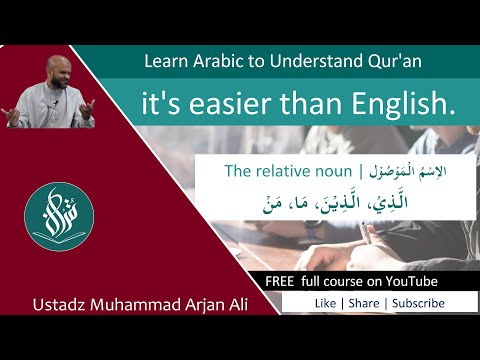 Click to play
Key Vocabulary
| Arabic | Transliteration | Meaning | Type |
|---|---|---|---|
| الاسْمُ الْمَوْصُولُ | al-ismu al-mawsool | the relative noun — "the connected noun" | ISM |
| الأَسْمَاءُ الْمَوْصُولَةُ | al-asmā' al-mawsoolah | the relative nouns (plural) | ISM |
| صِلَةُ الْمَوْصُولِ | silatu al-mawsool | the completion clause — the phrase or sentence that completes the relative noun | ISM |
| الَّذِي | alladhee | who / which / that (singular masculine) — 304x in Quran | ISM |
| الَّتِي | allatee | who / which (singular feminine) — 68x in Quran | ISM |
| الَّذِينَ | alladheena | those who / who (plural masculine or mixed) — 1059x in Quran | ISM |
| مَنْ | man | who / whoever (used for aqil — rational beings) — 650x as relative noun | ISM |
| مَا | mā | what / whatever / that which (used for non-aqil) — 1476x as relative noun | HARF |
Introduction
The relative noun (الاسْمُ الْمَوْصُول) is the last of the seven categories of definite ism studied in Book One. Relative nouns connect two parts of a sentence — similar to English "who," "which," and "that." They are used more than 3,500 times in the Quran, making them one of the most essential structures to recognise.
The Concept
### What Is the Ism Mawsool?
The root of مَوْصُول is و ص ل — to connect. The ism mawsool is the "connecting noun" — it joins what comes before it (the antecedent) to a following clause that completes the meaning.
On its own, the ism mawsool is incomplete. It always requires a following structure called the صِلَة (sila) to complete its meaning:
- الرَّجُلُ الَّذِي... (the man who...) — incomplete without sila
- الرَّجُلُ الَّذِي رَجَعَ مِنَ الحَجِّ — complete: the man who returned from hajj
### What Can Serve as Sila?
The sila that follows an ism mawsool can be one of four structures:
| Sila type | Example | |-----------|---------| | Jumlah fi'liyyah (verbal sentence) | الَّذِينَ آمَنُوا — those who believed | | Jumlah ismiyyah (nominal sentence) | الَّذِينَ هُمْ فِي صَلَاتِهِمْ خَاشِعُونَ — those who are in their prayer humbly submissive | | Jar-majroor (prepositional phrase) | الَّذِي فِي السَّمَاءِ — the one who is in the sky | | Zarf/Dharf (adverbial phrase) | الَّذِي عِنْدَكَ — the one with you |
The overwhelming majority of the time the sila is a verbal sentence (jumlah fi'liyyah).
### Always Definite — Always Mabni
Isms mawsoola are:
- Always definite (they belong to the 5th category of definite)
- Always mabni (non-declining — their form does not change for rafa'/nasb/jar)
### Specific Relative Nouns (Always Relative)
These words are used only as relative nouns — no other function:
| Word | Gender/Number | Frequency in Quran | Meaning | |------|--------------|-------------------|---------| | الَّذِي | singular masculine | 304x | who, which, that | | الَّتِي | singular feminine | 68x | who, which | | الَّذِينَ | plural masculine (or mixed) | 1059x | those who | | اللَّذَانِ / اللَّذَيْنِ | masculine dual | 1x each | the two who | | اللَّوَاتِي / اللَّائِي | plural feminine | 9x / 4x | those women who |
Priority for memorisation: الَّذِي، الَّتِي، الَّذِينَ — these three cover the vast majority of usage.
### الَّذِي — Singular Masculine and More
الَّذِي is used for:
- Singular masculine aqil (human): الرَّجُلُ الَّذِي جَلَسَ هُنَا — the man who is sitting here
- Singular masculine ghayru aqil (non-human): الكِتَابُ الَّذِي عَلَى الْمَكْتَبِ — the book that is on the desk
Translation: "who" for humans; "which/that" for non-humans — depends on English context, not Arabic.
### الَّتِي — Singular Feminine and Non-Aqil Plurals
الَّتِي is used for:
- Singular feminine (aqil or ghayru aqil)
- Plural of non-aqil (broken plurals or non-human plurals are treated as singular feminine in Arabic grammar)
Example: الكُتُبُ الَّتِي عَلَى الْمَكْتَبِ جَدِيدَةٌ — The books that are on the desk are new.
### Non-Specific Relative Nouns
Two particles can also function as relative nouns but have other uses too:
مَنْ (man) — for aqil (rational beings)
- Used 650 times as a relative noun in the Quran
- Also used as a question word (مَنْ أَنْتَ؟ — who are you?)
- Context distinguishes the two uses — same as English "who"
مَا (mā) — for ghayru aqil (non-rational)
- Used 1476 times as a relative noun in the Quran
- Also used as negation, question word, and other functions
- Translation: "what," "that which," "whatever"
Quranic Evidence
الَّذِي = relative noun (connecting "your Lord" to what follows); خَلَقَ = sila (verbal sentence).
الَّذِينَ = plural relative noun; يُؤْمِنُونَ and يُقِيمُونَ = sila (verbal sentences).
مَنْ = relative noun for aqil (whoever); used inclusively for both male and female.
Summary
- الاسْمُ الْمَوْصُول (ism mawsool): connects an antecedent to a following completion clause (sila)
- Always definite, always mabni (non-declining)
- The sila is usually a verbal sentence; can also be a nominal sentence, jar-majroor, or adverbial phrase
- Three essential words to memorise: الَّذِي (304x), الَّتِي (68x), الَّذِينَ (1059x)
- الَّتِي is also used with non-aqil plurals (broken plurals treated as singular feminine)
- مَنْ (650x) = who/whoever for aqil; مَا (1476x) = what/whatever for non-aqil — both have other uses
- Combined frequency of relative nouns in Quran: over 3,500 times