The Six Baabs of Morphology
Form-1 Verb Patterns · Madi & Mudari Scales · Root System
- Explain why Arabic uses a root-and-pattern (scale) system instead of arbitrary word forms
- Name and recognise all six baabs (conjugation patterns) of Form-1 (mujarrad) verbs
- Identify a verb's baab from its madi and mudari middle root-letter vowel
- Conjugate 14 madi and 14 mudari forms for any verb once its baab is known
- Use the mnemonic sentence to recall all six baabs in order
- Look up and cite a verb's baab using the short-form letter codes (Fa, Nun, Dad, Sin, Ha, Kaf)
Video Lesson
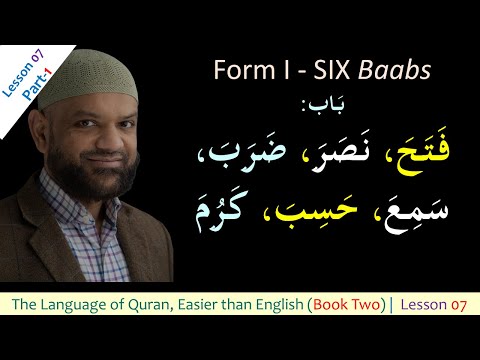 Click to play
Key Vocabulary
| Arabic | Transliteration | Meaning | Type |
|---|---|---|---|
| بَابٌ | bāb | door / chapter — the conjugation pattern a verb follows | ISM |
| أَبْوَابٌ | abwāb | doors / chapters — plural of bab | ISM |
| مُجَرَّدٌ | mujarrad | bare / stripped — Form-1 verb with three root letters only | ISM |
| فَتَحَ يَفْتَحُ | fataha yaftahu | he opened / he opens — template for Bab Fatha (Fa) | FIL |
| نَصَرَ يَنْصُرُ | nasara yansuru | he helped / he helps — template for Bab Nasara (Nun) | FIL |
| ضَرَبَ يَضْرِبُ | daraba yadribu | he struck / he strikes — template for Bab Daraba (Dad) | FIL |
| سَمِعَ يَسْمَعُ | sami`a yasma`u | he heard / he hears — template for Bab Sami'a (Sin) | FIL |
| حَسِبَ يَحْسِبُ | hasiba yahsibu | he reckoned / he reckons — template for Bab Hasiba (Ha), rare | FIL |
| كَرُمَ يَكْرُمُ | karuma yakrumu | he was noble / he is noble — template for Bab Karuma (Kaf), rare | FIL |
Introduction
A key insight in Arabic morphology (الصَّرْف) is that most words are built on three root letters and pass through a predictable scale (وَزْن). The scale determines the vowels placed on the root letters in both the madi (past tense) and the mudari' (present/future). Instead of memorising endless individual vowel patterns, we group verbs into six baabs (أَبْوَاب), each named after a common example verb. Once you know a verb's baab, you can produce all 28 conjugated forms (14 madi + 14 mudari') automatically.
The Concept
### The Root-and-Scale System
Every Arabic verb in Form-1 is built on three root letters represented as ف ع ل (fa', 'ayn, lam). The only variable in the madi scale is the vowel on the middle root letter:
| Scale | Middle vowel (madi) | Example | |-------|---------------------|---------| | فَعَلَ | fatha (a) | فَتَحَ | | فَعِلَ | kasra (i) | سَمِعَ | | فَعُلَ | dhamma (u) | كَرُمَ |
The mudari' scale adds the letter of mudari' (ي ت أ ن) at the front and may change the middle vowel. Of the nine theoretical combinations (3 x 3), only six actually exist in Arabic:
### The Six Baabs
| Baab Name | Short Code | Madi scale | Mudari scale | Example verb | |-----------|-----------|------------|--------------|--------------| | بَابُ فَتَحَ | Fa (ف) | فَعَلَ (a) | يَفْعَلُ (a) | فَتَحَ يَفْتَحُ — to open | | بَابُ نَصَرَ | Nun (ن) | فَعَلَ (a) | يَفْعُلُ (u) | نَصَرَ يَنْصُرُ — to help | | بَابُ ضَرَبَ | Dad (ض) | فَعَلَ (a) | يَفْعِلُ (i) | ضَرَبَ يَضْرِبُ — to strike | | بَابُ سَمِعَ | Sin (س) | فَعِلَ (i) | يَفْعَلُ (a) | سَمِعَ يَسْمَعُ — to hear | | بَابُ حَسِبَ | Ha (ح) | فَعِلَ (i) | يَفْعِلُ (i) | حَسِبَ يَحْسِبُ — to reckon (rare) | | بَابُ كَرُمَ | Kaf (ك) | فَعُلَ (u) | يَفْعُلُ (u) | كَرُمَ يَكْرُمُ — to be noble (rare) |
Key rule: When the madi has dhamma (u), the mudari' will also have dhamma — Bab Karuma is the only possibility.
### Mnemonic to Remember All Six in Order
> Open the Quran — فَتَحَ يَفْتَحُ > Allah will help you — نَصَرَ يَنْصُرُ > Otherwise the dunya will beat you — ضَرَبَ يَضْرِبُ > Therefore listen carefully — سَمِعَ يَسْمَعُ > And count your good deeds — حَسِبَ يَحْسِبُ > And be noble — كَرُمَ يَكْرُمُ
### Focus: Baab Nasara (Most Common)
Bab Nasara is the most frequently encountered pattern in Quranic Arabic. Common verbs following this pattern:
| Root | Verb | Meaning | |------|------|---------| | ك ف ر | كَفَرَ يَكْفُرُ | to disbelieve | | خ ل ق | خَلَقَ يَخْلُقُ | to create | | ذ ك ر | ذَكَرَ يَذْكُرُ | to remember | | ع ب د | عَبَدَ يَعْبُدُ | to worship | | ر ز ق | رَزَقَ يَرْزُقُ | to provide | | ق ت ل | قَتَلَ يَقْتُلُ | to kill |
### How to Use Baab Information
When vocabulary is presented with its baab code, you can immediately produce all forms. For example:
ج ع ل (Fa) → جَعَلَ يَجْعَلُ — he made / he makes ع ب د (Nun) → عَبَدَ يَعْبُدُ — he worshipped / he worships غ ف ر (Dad) → غَفَرَ يَغْفِرُ — he forgave / he forgives
### Beyond Form-1: A Preview
Form-1 (mujarrad, six baabs) is the foundation. Forms 2–10 are called mazeed (مَزِيد) — they add extra letters to the root. The same conjugation rules apply to all forms; only the root template differs. Form-1 produces the majority of Quranic verbs.
Quranic Evidence
خَلَقَ follows Bab Nasara — خَلَقَ يَخْلُقُ (root: خ ل ق).
يَعْبُدُونَ follows Bab Nasara — عَبَدَ يَعْبُدُ (root: ع ب د), here in mudari' plural form.
Summary
- Arabic verb conjugation is rule-based: learn the root + baab, get 28 forms free
- Six baabs exist in Form-1 (mujarrad); three theoretical combinations do not exist in Arabic
- The middle root letter vowel identifies the baab: a/a = Fatha (Fa), a/u = Nasara (Nun), a/i = Daraba (Dad), i/a = Sami'a (Sin), i/i = Hasiba (Ha — rare), u/u = Karuma (Kaf — rare)
- Priority: focus on the first four baabs (Fa, Nun, Dad, Sin) — they cover the overwhelming majority of Quranic verbs
- Short codes (Fa, Nun, Dad, Sin, Ha, Kaf) will be used in all future vocabulary lists to indicate a verb's pattern