Kana with Al-Madi
Using كَانَ to Express the Distant Past in the Verbal Sentence
- Understand the difference between the near past (al-maadi al-qareeb) and the distant past (al-maadi al-ba'eed)
- Use كَانَ with a maadi verb to express that an action happened in the distant past
- Match the sigha of كَانَ with the sigha of the following maadi verb
- Recognise كَانَ as a fi'lun naaqis (defective verb) and understand what that means
Video Lesson
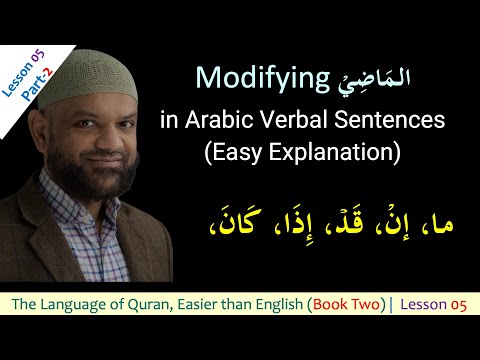 Click to play
Key Vocabulary
| Arabic | Transliteration | Meaning | Type |
|---|---|---|---|
| كَانَ | kaana | he was / he had (auxiliary — distant past marker) | FIL |
| الْمَاضِي الْقَرِيبُ | al-maadii al-qareeb | the near past ("he has just done") | ISM |
| الْمَاضِي الْبَعِيدُ | al-maadii al-ba'eed | the distant past ("he had done") | ISM |
| فِعْلٌ نَاقِصٌ | fi'lun naaqis | defective verb — a verb whose meaning is incomplete without a complement | ISM |
| أَفْعَالٌ نَاقِصَةٌ | af'aalun naaqisa | defective verbs (plural) | ISM |
| قَدْ | qad | particle of emphasis / near past marker ("certainly / has just") | HARF |
| نَصَرَ | nasara | he helped | FIL |
| فَتَحَ | fataha | he opened | FIL |
Introduction
In the previous parts of Lesson 5 the teacher covered all the main ways to modify the meaning of a maadi verb: negation with مَا and لَا, emphasis and near-past meaning with قَدْ, future meaning with إِذَا and إِنْ, and certainty with لَ. The one thing that remained was expressing an action that happened in the distant past — something that occurred a long time ago rather than just recently. That is the subject of this part of the lesson.
The lesson opens with a review screen showing every modifier learned so far alongside example sentences, so students can see the full picture before the new concept is introduced. Once the review is complete, the teacher turns to كَانَ and explains its unique grammatical category and how it shifts the time frame of any maadi verb it is placed before.
A key practical note is that كَانَ itself must be conjugated to match the internal doer of the following maadi verb. Because كَانَ contains a weak middle letter (originally كَوَنَ with a waaw), its forms look slightly different from a sound verb, but the principle of matching the sigha is exactly the same as with any other verb.
The Concept
### Qad vs Kana — Near Past vs Distant Past
قَدْ is a harf (particle) of emphasis. When placed before a maadi verb it also adds the meaning of "just recently" or "has certainly done." For example:
قَدْ نَصَرَ = he has just helped / he has certainly helped (al-maadi al-qareeb — near past)
كَانَ, by contrast, is itself a verb — a fi'lun naaqis. When placed before a maadi verb it pushes the meaning back into the distant past:
كَانَ نَصَرَ = he had helped (al-maadi al-ba'eed — distant past)
The term fi'lun naaqis (defective verb) means that كَانَ alone does not give a complete picture. It describes a state or time frame but needs something more to complete its meaning. That is why it is always paired with another element — either a jumlah ismiyyah (as studied in Book One) or, as in this lesson, a maadi verb.
### Kana with Jumlah Ismiyyah — A Reminder
When كَانَ is used with a nominal sentence (jumlah ismiyyah) it converts the khabar (predicate) from rafa' to nasb. The subject is then called ismu kaana and the predicate is called khabaru kaana, which must be mansoob. This was covered in Book One with لَيْسَ as well.
كَانَ الرَّجُلُ كَرِيمًا kaana ar-rajulu kariiman The man was generous. (ismu kaana = ar-rajulu [rafa'], khabaru kaana = kariiman [nasb])
### Kana with Al-Madi — Matching the Sigha
When كَانَ precedes a maadi verb, both verbs must share the same sigha — the same person, gender, and number. There is no irab change to worry about because both are maadi forms, but the internal doer of كَانَ and the internal doer of the following verb must match exactly.
Examples using the verb فَتَحَ:
| كَانَ form | Maadi form | Meaning | |-----------|-----------|---------| | كَانَ | فَتَحَ | he had opened | | كَانَا | فَتَحَا | they two (m.) had opened | | كَانُوا | فَتَحُوا | they (m.pl.) had opened | | كَانَتْ | فَتَحَتْ | she had opened | | كَانَتَا | فَتَحَتَا | they two (f.) had opened | | كُنَّ | فَتَحْنَ | they (f.pl.) had opened | | كُنْتَ | فَتَحْتَ | you (m.sg.) had opened | | كُنْتُمَا | فَتَحْتُمَا | you two had opened | | كُنْتُمْ | فَتَحْتُمْ | you (m.pl.) had opened | | كُنْتِ | فَتَحْتِ | you (f.sg.) had opened | | كُنْتُمَا | فَتَحْتُمَا | you two (f.) had opened | | كُنْتُنَّ | فَتَحْتُنَّ | you (f.pl.) had opened | | كُنْتُ | فَتَحْتُ | I had opened | | كُنَّا | فَتَحْنَا | we had opened |
Note: the middle letter of كَانَ is a weak waaw. In the past tense forms it becomes an alif (كَانَ), and in forms where it would follow a vowelless letter it disappears (كُنْتُ, كُنَّا, etc.). The same sigha principle applies regardless of this phonetic change.
### Summary of Maadi Prefixes
The teacher concludes with a full summary chart of everything that can be placed before a maadi verb:
| Prefix | Type | Function | |--------|------|---------| | وَ | harf | and | | فَ | harf | so / then | | لَ | harf | emphasis | | قَدْ | harf | emphasis / near past | | مَا | harf | negation | | لَا | harf | negation (repeated) | | إِذَا | harf | future (certain event) | | إِنْ | harf | future (possible event) | | كَانَ | fi'l naaqis | distant past |
Common combinations include: وَقَدْ، فَقَدْ، لَقَدْ، وَلَقَدْ، وَكَانَ، فَكَانَ.
Quranic Evidence
Summary
- قَدْ before a maadi verb adds emphasis and the sense of "just recently" (al-maadi al-qareeb — near past).
- كَانَ before a maadi verb shifts the action to the distant past (al-maadi al-ba'eed) — "he had done."
- كَانَ is a fi'lun naaqis (defective verb): its meaning is incomplete on its own and it needs a complement to give a full picture.
- Both كَانَ and the maadi verb that follows it must share the same sigha (person, gender, number).
- The root ك-و-ن (kaana / yakuunu / kun) appears approximately 1,400 times in the Quran, making it one of the most important verbs to master.
- All modifiers of the maadi — negation, emphasis, future, near past, distant past — are now complete and can be combined (e.g. وَلَقَدْ، فَكَانَ).