Modifying Al-Māḍī — Part One
Negation · Qad · Idhā and In · Du'ā
- Negate the māḍī using مَا and لَا
- Use قَدْ to express emphasis and the near past
- Use إِذَا with the māḍī to express a certain future action
- Use إِنْ with the māḍī to express a conditional future
- Recognise al-māḍī used as du'ā (supplication)
Video Lesson
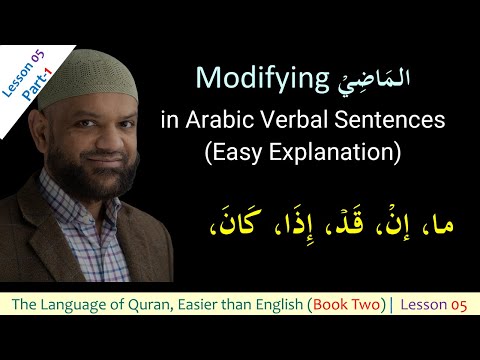 Click to play
Key Vocabulary
| Arabic | Transliteration | Meaning | Type |
|---|---|---|---|
| مَا | mā | particle of negation for the perfect tense — "did not" | HARF |
| لَا | lā | particle of negation (often doubled) — "neither... nor..." | HARF |
| قَدْ | qad | particle of emphasis/near past — "certainly" / "has just..." | HARF |
| إِذَا | idhā | adverbial particle — moves māḍī meaning to the future with certainty — "when" | HARF |
| إِنْ | in | conditional particle — moves māḍī meaning to an uncertain future — "if" | HARF |
| دُعَاءٌ | du'ā | supplication — the māḍī is used to express it with certainty | ISM |
Introduction
Lesson 5 builds directly on the foundation of the māḍī conjugation. We now learn the particles and constructions that modify the perfect tense verb — negating it, emphasising it, shifting its meaning to the future, and using it in du'ā. These patterns appear hundreds of times in the Quran and in everyday Islamic speech.
The Concept
### 1 — Negating the Māḍī with مَا
The simplest tool for negating the perfect tense: place مَا before the verb. Nothing else in the sentence changes.
مَا + [māḍī verb] = negation of the past action No change to case endings, gender, or number.
Examples:
- ذَهَبْتُ إِلَى الْمَدْرَسَةِ → I went to school
- مَا ذَهَبْتُ إِلَى الْمَسْجِدِ → I did not go to the mosque
- مَا سَمِعْتُ الْأَذَانَ → I did not hear the adhān
- مَا نَصَرَ زَيْدٌ حَامِدًا → Zayd did not help Hamid
مَا has many uses in Arabic (question word, relative pronoun, negation of nominal sentences). Here it negates the perfect tense verb.
### 2 — Negating the Māḍī with لَا
لَا can also negate the māḍī, but is typically used in double negation — denying two things together with وَلَا:
لَا [verb] وَلَا [verb] = "neither... nor..."
Examples:
- لَا أَكَلْتُ وَلَا شَرِبْتُ — I neither ate nor drank
- لَا قَرَأَ وَلَا كَتَبَ — He neither read nor wrote
Quranic example: فَلَا صَدَّقَ وَلَا صَلَّى (Al-Qiyāmah, 75:31) — "So he neither believed nor prayed."
### 3 — Emphasising and Expressing the Near Past with قَدْ
قَدْ placed before the māḍī does two related things:
Near past — the action just happened / has recently been completed:
- قَدْ فَتَحُوا الْمَسْجِدَ — They have just opened the mosque
- قَدْ نَصَرْتُ حَامِدًا — I have just helped Hamid
Emphasis/certainty — the action has definitely occurred:
- قَدْ ذَهَبَ حَامِدٌ — Hamid has certainly gone
The two meanings are related — both bring the past action closer to the present moment of speaking. Context determines which English translation works best.
قَدْ is a particle (harf) — it never changes for gender, number, or person. It appears approximately 400 times in the Quran.
It may combine with لَ for double emphasis: لَقَدْ — "certainly indeed":
- لَقَدْ كَفَرَ الَّذِينَ قَالُوا... — They have certainly disbelieved, those who said... (Al-Mā'idah, 5:72)
### 4 — Moving the Māḍī to the Future with إِذَا
إِذَا placed before a māḍī verb shifts the action from past to a certain future. In English this becomes "when":
إِذَا + [māḍī verb] = "when [action happens]" — future with certainty
Examples:
- إِذَا وَقَبَ — when it becomes intense (Al-Falaq, 113:3)
- إِذَا جَاءَ — when he/it comes
- إِذَا قُمْتُمْ — when you stand up
إِذَا is an adverbial particle of time. It takes the past tense form of the verb but carries a future meaning — the event is expected to happen with certainty.
### 5 — Conditional Future with إِنْ
إِنْ with the māḍī expresses a conditional uncertain future — translated as "if":
إِنْ + [māḍī verb] = "if [action happens]" — conditional, may or may not occur
Difference from إِذَا: إِذَا signals something that will certainly happen; إِنْ signals something that depends on a condition.
### 6 — Al-Māḍī as Du'ā
The perfect tense is used in supplications with a future meaning — not because the action has occurred, but because the du'ā is made with such certainty of acceptance that the past tense is used.
| Du'ā | Transliteration | Meaning | |------|----------------|---------| | رَحِمَهُ اللَّهُ | Raḥimahullāh | May Allah have mercy on him | | غَفَرَ اللَّهُ لَهُ | Ghafara Allāhu lahu | May Allah forgive him | | جَزَاكَ اللَّهُ خَيْرًا | Jazākallāhu khayran | May Allah reward you with good | | حَفِظَهُ اللَّهُ | Ḥafiẓahullāh | May Allah protect him |
Note: Saying جَزَاكَ اللَّهُ alone is incomplete — always add خَيْرًا to complete the meaning.
Quranic Evidence
Summary
- مَا placed before any māḍī verb negates it. No change to the verb's form.
- لَا is typically used for double negation: لَا... وَلَا... (neither... nor...)
- قَدْ before the māḍī expresses either the near past ("has just...") or strong emphasis ("certainly has..."). It appears ~400 times in the Quran.
- إِذَا + māḍī = "when" — shifts the action to a certain future event.
- إِنْ + māḍī = "if" — shifts the action to a conditional future event.
- Du'ā uses the māḍī with a future meaning — the certain hope of acceptance makes the past tense appropriate.